I'm thankful for the pilgrims for hacking out an existence in the great American wilderness and gaining a toe-hold for freedom and individualism.
 The planes in question are the rocket powered Bell X-1 and the Boeing B-29 Superfortress. I meant to post this on October 13th, which would have marked the 61st anniversary of catching the demon. A great moment in history. Chuck Yeager is a hero. What better way to commemorate the event than with a video of the coolest model airplane I've ever seen:
 Another, possibly the last, installment (pgs 289-290) from Baa Baa Black Sheep - though there are plenty of other excerpts worthy of posting. In this episode Boyington has been a prisoner for about a year (January 1945). The first significant air raids over the Tokyo Bay area have just begun with a carrier based strike. Ofuna, the interrogation camp where Boyington is stationed, is about 10 miles from Yokosuka:
 Dive bomber after dive bomber started down, the hills between the target area and our camp momentarily chopping each bomber from view, making it appear as though they were diving into the hills. But in a few seconds we saw them pull out about the same time we heard the ka-lumph of the exploding bomb. Even at this distance the noise from so many engines sounded much the same as a gigantic waterfall – a steady roar. Obviously this was not a moral strike like the Doolittle raid; this was concentrated, and we knew that this carrier raid was the beginning of the end for Japan.
 What a sight, I thought, as I saw a Zero scooting low along the hilltops directly over our camp, being chased by a Navy F6F. An old familiar feeling came over me, causing a tingling to run through my body, as I watched the F6F pour his .50-caliber machine guns into the hapless Zero, which belched flame and crashed into the hillside as the F6F pulled skyward. I knew he was looking for new prey, for I felt close enough to the action, while standing there on the ground, almost to feel that I was thinking for that Navy F6F pilot.
 “Flat on your belly is the safest place I know of.” I tried to console this excited and frightened man. Curly must have taken me as an authority when I spoke, for he was flat on his face before I had finished.
 Still more Boyington. There will be one or two more posts yet from his exceedingly impressive Baa Baa Black Sheep. For almost the last two years of the war he was a captive with the Japanese. Not a P.O.W., but a "special prisoner," which meant that word of his survival was not sent to the U.S. via the Red Cross. Conditions were harsh, as one would expect, but Boyington points out that his own treatment wasn't as horrendous as what others endured. Still, it was unimaginably bad. Yet, Boyington recognized that the Japanese weren't bad people. He ran across several moments of kindness, mostly from civilians and the military personel that spoke English. Obasan (correct spelling) was one that really stuck out. In this episode, Boyington has been a captive of the Japanese for several months. He's being held at the interrogation center at Ofuna - between Yokohama and Sagami Bay, a few miles from Yokosuka, where the U.S. Naval Base is today:
 I guess everybody is inherently dishonest in some shape or form, or manner, so I stole food. I never stole any of the prisoners’ food, of course, but I stole the Japanese food, which was a great deal more nourishing, and more tasty.
 The first time she ever handed me one of these hot fish I stuffed it immediately down my throat to avoid detection. The thing was so hot I had to grab the tail between my front teeth in a futile effort to stop it from sliding on down and burning my stomach. And there I stood – tears running out of my eyes, a guard asking: “Nunda” – while I was pretending to blow my nose and still keep from choking on the hot fish.
 Anyhow, Obason said she longed for the days when the automobiles were going up and down the streets. For months before the war there was nothing but a few of those coke-burning trucks that have to be pushed up every hill, and they all carried a crew of about ten men, and every time they would come to a slight hill, they would have to shove the truck up the hill. They would go all right on the level provided they had practically no load.
 More Pappy from his book, Baa Baa Black Sheep (pages 131-137). This time he's in the Pacific with his newly formed (and unorthodox) squadron, the famous VMF-214 Black Sheep flying the great Chance-Vought F-4U Corsairs. Their legitimacy as a permanent squadron hangs in the balance as Pappy desperately tries to find some enemy action in the hope that they can impress the brass and keep their borrowed squadron designation. In this excerpt, the Black Sheep's mission is to escort some dive-bombers (Douglas SBD Dauntlesses and Grumman TBF Avengers) on a strike over the Solomon Islands:
 Take-off time – the last Dauntless had wobbled lazily into the air, starting to turn in one gigantic join-up circle. We took off in pairs down the snow white coral strip at about twenty-second intervals, which was a feat in itself, because none of us had more than approximately thirty hours in these powerful new speed birds.
 Thoughts of how we might louse up the all-important rendezvous after take-off were far behind. We had made that. And the rendezvous ahead, after our mission was accomplished, certainly couldn’t have bothered me. For the Brass couldn’t possibly see that, only the Nips could. And I don’t believe I gave too much thought to them.
 To add to my bewilderment, shortly after we cleared the last bit of fluff, I saw that we were right in the middle of about forty Jap fighters. As for us, we had twenty planes that day.
 A few pilots I had run into before, and some since, can relate every minute detail about an enemy aircraft they came in contact with. But I’ll be damned if I can remember much more than round wing tips, square tips, liquid-cooled, air-cooled, and of course the horrifying Rising Sun markings.
 Something else entered my mind after the initial surprise and fright were over, something I realized much more keenly than any of the pilots accompanying me on this mission. I am positive, for I had been involved in this deadly game with Mars for two long years. What I knew only too well was that the average pilot gets less than one chance in a hundred missions of being in a position to fire a killing burst. And furthermore, when this rare chance comes, the one in a hundred, nine out of ten times the pilot is outnumbered, which cuts down his chances still further. Insight into these odds came to me very vividly, for I had tried my best for over two years. Yet my score to date was six. A great number of my previous mistakes suddenly came before me. Realizing that there was meat on the table that might never be there again, as far as I personally was concerned, I was determined to make hay while the sun shined.
 As I turned into this pal, I made a head-on run with him. Black puffs came slowly from his 20-millimeter cannons. His tracers were dropping way under my Corsair. I could see my tracers going all around this little Zero. When I got close enough to him, I could see rips in the bottom of his fuselage as I ducked underneath on my pass by. The little plane nosed down slowly, smoking, and crashed with a splash a couple seconds later, without burning or flaming.
 It was impossible for me to see this flamer crash. By this time, I was too occupied getting my plane out of the spin before I hit the water too. I did, however, shoot a sizable burst into the second Zero a few seconds later. This Zero turned northward for Choiseul, a nearby enemy-held island but without an airstrip. The only thing I could figure was that his craft was acting up and he planned upon ditching as close to Choiseul as he could. Anyhow I didn’t have sufficient gas to verify my suspicions.
 The armorers came out to rearm my plane and informed me that I had only thirty rounds of .50-caliber left, so I guess I did come back at the right time.
 Another excerpt from Pappy's Baa Baa Black Sheep - during his Flying Tiger days:
 Off we went in the shark-faces, and as we circled the field, climbing, we could see the official cars stop and let out Madame and the Generalissimo. Much bowing and handshaking could be detected in the tiny forms down on the field, the official party next to the transport.
 One pilot with very limited flying experience told us afterwards that he had rolled quite naturally to the upside down position by merely following the P-40 in front of him, but when the time came to roll right side up again, he was a total loss because the P-40 in front of him had left his vision by pulling up. He said the only thing that saved him was remembering: center the needle and then the ball, which was taught him in instrument-flying school.
 As I recall, one other plane dropped out of formation, too, leaving only six of us. The tired old P-40s were weak from lack of spare parts and from other ailments.
 Knowing that no Japs could possible find a DC-2 in that cloudy weather, I wobbled my wings good-by to the transport pilot and started my own fighters back from home or some landing place. But with my compass not working, and my radio not working, and no familiar landmark anywhere, all I could do was to try to guide our way back out of the thick clouds and be able to see something. The whole thing became a race between the clouds and our remaining gas.
 Each plane, on being stopped in this manner, would skid along on its belly, damaging the landing gear even though it was retracted, and either one or the other wing tip in some cases. But what surprised us after that was the speed with which we immediately became surrounded by a horde of Chinese. All of us had not yet had a chance to drag ourselves from the damaged planes before the Chinese began pouring in around us. We did not know at the time where so many could be coming from, but it turned out that they were coming from a neighboring village and there were hundreds and hundreds of them. None of them seemed to understand English, but they stood there and stared back at them.
 Jim Adams and Bill Tweedy did everything a little differently from the way other wealthy colonials acted there in Rangoon. They came out to Mingaladon in person and picked up six of us AVG pilots. It was very cute, I thought, the way the inseparable pair worked together. Later, I learned, they had continued this relationship, which started when they served together in World War I. As two young men, they had realized the lack of opportunity in Scotland and had struck out to the colonies to better themselves, remaining there ever since. Jim and Bill were in the oil-refining business in Burma. Both were bachelors and always had been. And both of them had selected picturesque knolls in suburbs of Rangoon, where they had constructed their dream estates, approximately a half mile from one home to the other. The construction, the landscaping, the servants, everything appeared to blend in peaceful harmony. Jim Adams came directly to the point when they picked us up at the field, and asked us to come live with them. He said: "Bill and I have spent most of our lives in comparative comfort. But we know what the other side is like. And we decided it was awfully selfish of us, not sharing our homes with you fellows, who are the only reason we are able to live in them."
 By this time all of the pilots had been billeted with different colonials in their homes. However, the six of us, living with Jim Adams and Bill Tweedy, were the only pilots whose hosts had insisted that no room and board be paid. Furthermore, they dropped everything of importance to make us feel at home, and we became inseparable.
 These evenings out of doors were augmented by typical Southern California weather that February of 1942. After we briefly accounted for the day, we downed our Burra Pegs and excused ourselves, then retired to our quarters to freshen up before continuing the enjoyable evening with our hosts. For these two Scots were the same as foster parents.
 Usually I entered the bedroom relieving myself of my dirty, sticky clothing as I walked. And by the time I entered the bathroom there was always a hot tub waiting, and the proper temperature for me. Perfect coordination, regardless of the hour I arrived. And Anto, a husky Burmese, the number-one boy, had already left unseen through the outside bathroom entrance. Nor do I remember ever calling for Anto to serve me; he must have had telepathy in addition to all his other fine attributes. If not before, I soon discovered, after I had eased myself into this refreshing tub, that cigarettes, matches, and a cool, fresh "Burra Peg" were within easy reach.
 The mornings, even though I was awakened before sunrise, were equally pleasant - no clanging alarm clock, no bugler, merely the delightful aroma of freshly brewed tea. This came from a teapot and a poured cup upon a table beside my pillow. And for once in my life I was able to get out of bed by degrees and enjoy myself. The cup of tea was very nearly consumed by the time I had finished a cigarette and had gotten my other slipper on my foot. Then into the bathroom for a shave and a toothbrush I went. Upon returning to my bedroom I found fruit, ham and eggs, marmalade and toast, and more tea, placed upon the little table beside my bed. What a way to live! How could I ever forget this part?
 Jim and Bill insisted upon my coming to their room for a couple of "Pegs" for old times' sake. I couldn't help feel sorry for these two sweet Scots, who, after nearly thirty years of comfortable living, were in a ten-by-twelve room with no bath.
 The crew left the bomb bay doors open and Sergeant McAfee and Lieutenant Cooper went to work, trying to trigger the little steel catches on each end of the bomb, hoping to pry them open so the bomb would drop. McGovern remembered: "It was scary as hell. If the plane suddenly made a lunge when the 500-pound bomb dropped..."
 The Dakota Queen descended to 12,000 feet, several thousand feet below the formation, which was pulling ahead in any case. Then Cooper yelled something "and all of a sudden the plane jumped and I knew the bomb had been cut loose." They were approaching the Austrian-Italian border. McGovern watched the bomb descend, "a luxury you didn't have at 25,000 feet. It went down and hit right on a farm in that beautiful, green part of Austria. It was almost like a mushroom, a big, gigantic mushroom. It just withered the house, the barn, the chicken house, the water tank. Everything was just leveled. It couldn't have come in more perfectly. If we had been trying to hit it we couldn't have hit it as square. you could see stuff flying through the air and a cloud of black smoke."
 Cooper looked at his map, did his calculations, and replied, "Eight thousand feet, George. Eight thousand feet." In an interview he admitted, "Actually, it was only 7,000 feet, but I added another 1,000 feet because I was engaged to get married." Cooper grinned, then added, "As George was expecting his first child, he added another 1,000 feet on top of that."
 He went over to the officers club and had a drink - cheap red wine. He was toasted and cheered. But, he later said, "It really did make me feel different for the rest of the war. Now I was a father, I had not only a wife back home but a little girl, all the more reason why I wanted to get home and see that child." He returned to his tent and wrote Eleanor a long letter. He did not mention the farmhouse but he couldn't get it out of his mind. "That thing stayed with me for years and years. If I thought about the war almost invariably I would think about that farm."
 McGovern told her about the bomb that had stuck in the bomb bay door and had to be jettisoned, on March 14, 1945. "To my sorrow it hit a peaceful little Austrian farmyard at high noon and maybe led to the death of some people in that family. I regret that all the more because it was the day I learned my wife had given birth to our first child and the thought went through my mind then and on many, many days since then, that we brought a young baby into the world and probably killed someone else's baby or children."
 Earlier this spring my parents took a trip to San Diego and visited the USS Midway - now the most visited floating museum in the world. It was a special event, particularly for my dad, who'd served on the Midway as an A-6 pilot in the mid-70s.
 Like her name suggests, the USS Midway was born out of battle hardened experience and wartime ingenuity. There is something almost organic about her life - even during the earliest moments of construction the Midway was adapting to a changing world. For 47 years she went through a variety of modernizations that kept her and her men at the vanguard of U.S. naval power, responding to crises and providing service well beyond the scope of her planners' intentions. Today's role of aircraft
  carriers, in no small degree, is born out of what the Midway did as experimentation and precedence. She's been a nuclear deterrent, a scientific guinea pig, an escape for refugees, a symbol of American power and humanity, and, of course, a lethal weapon. The Midway has handled WWII era warbirds and today's Hornet and a good chunk of everything in between and has been a showroom of seafaring aviation. All in all, the Midway’s story serves as a microcosm of U.S. Naval evolution during its most dynamic and tumultuous period in terms of technological advancement and political importance to the world. If you wanted to get an idea at what the U.S. Navy was up to at any given time from 1945 to 1991, taking a look at what the Midway was doing would give you a pretty good glimpse.
 The Midway’s hull, ordered in 1942 and laid down at Newport News Shipbuilding and Dry Dock, was originally planned for a new Montana class of battleship. It incorporated innovations and ideas picked up after the early battles in the Pacific War - thicker steel and more transverse bulkheads - innovations that provided extra protection against torpedo attacks. In the wake of the Battle of Midway and other action, the Navy had also noticed the rise in importance of aircraft carriers and focused more urgent construction towards them. Using the Midway's giant battleship hull for a new larger class of carrier was a tricky endeavor, but made sense during the rushed wartime construction of 1943. The unique design gave the Midway excellent
  maneuverability, uncommon for a carrier, but those same features also caused her to pitch and roll excessively. The weight of the flight deck further aggravated her ability to launch and retrieve aircraft in heavier waters. Athough six Midway class carriers were planned, only three were actually built and, for the first ten years of her life, the Midway was the largest ship in the world - the first of a succession of carriers to be too large to pass through the Panama Canal.
 The Midway was commissioned days after the Pacific War ended in 1945 sponsored by Mrs. Bradford D. Ripley II, the widow of a naval aviator who died in the war (she was also known as Heiress Barbara Cox Anthony, one of the richest women in Hawaii). She was accompanied by Lt. George Gay who was part of VT-8, a squadron that was almost entirely wiped out during the Battle of Midway. Lt. George Gay was the only survivor of 30 men. While he floated in the water, he witnessed the American attack that sank three Japanese carriers and instantly turned the tide of the war before being picked up the next morning by a PBY. Lt. Gay later served with the VT-11 over Guadalcanal, a squadron that years later would serve on the Midway for two decades as the VA-115.
 Norfolk was the Midway's first home. After a shakedown cruise in the Caribbean, she served in the Atlantic as the Flagship for Carrier Division 1. During Operation FROSTBITE (1946) the Midway sailed in the Labrador Sea, near the Arctic Circle, testing carrier flight operations in extreme cold conditions, often with 3 to 4 inches of snow and ice on the deck. This operation was made particularly relevant by the prominence of the Soviet navy who operated in similar waters. The Midway's stability concerns, first perceived during the shakedown cruise, became more acute in the choppy North Atlantic waters.
 The Midway was back in the Caribbean in September of 1947 for Operation SANDY, in which a captured V-2 rocket was launched off the carrier's unmodified flight deck. It was the first time a rocket had been fired off a moving platform or a ship at sea. In this regard, Operation SANDY was the dawn of naval missile warfare. Given the unpredictable nature of the V-2, the launch was an extremely dangerous venture. The V-2 cleared the ship's conning tower, then tilted off course and was destroyed before it could reach any nearby islands.
 From November of 1947 to March of 1948, the Midway made the first of seven voyages to the Mediterranean. On the second Mediterranean cruise, from January to March of 1949, the Midway launched a large P2V Neptune on a nonstop 25 hour 4,800 mile flight to San Diego with a detour over the Panama Canal and Corpus Christi to display its nuclear strike capability. The Navy had modified twelve Neptunes to launch from one of the three Midway class carriers. They were too large to use the ships' hydraulic catapults and had to use booster rockets for take-off. Nor could the Neptune land on the carriers. At the time, however, the Neptune was the only aircraft available that could make a carrier launch, even under such particular conditions, carrying a 9000 lb. atomic bomb.
 The Midway returned to the North Atlantic in 1949, this time operating within the Arctic Circle and earning her entry into the The Royal Order of the Blue Nose. By 1950 she was back in the Mediterranean and was the Flagship of Air Group Four. When war broke out in Korea, the Midway, instead of rushing to the scene, was kept in the Mediterranean to maintain the nuclear deterrent against the Soviet Union. At the time, only the Midway class carriers were capable of handling the planes large enough to carry nuclear bombs, and the need for her to guard NATOs southern flank was more urgent than providing air support in the Korean theater.
 Returning to Norfolk after a fourth cruise to the Mediterranean, the Midway received several modifications - namely the removal of some guns to reduce weight and extra reinforcement to the flight deck so that she could handle heavier jet aircraft as well as the composite engine Savage, which replaced the P2V Neptune. In January of 1952, the Midway was back in the Mediterranean for the fifth time - this time with Air Group Six - participating in a NATO exercise called Operation GRAND SLAM.
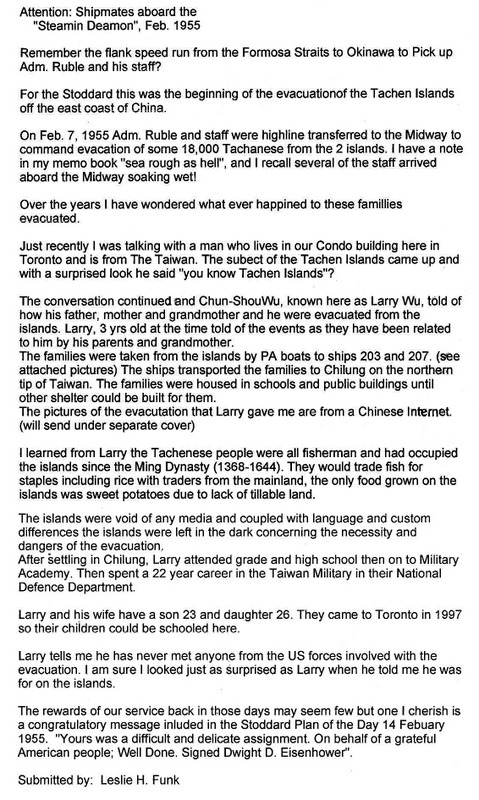
 nearby Tachen Islands (then controlled by the Nationalists), started shelling Tachen in preparation for an invasion. The Seventh Fleet, with the Midway as the flagship of Carrier Division Four, immediately took action. The USS Stoddard rushed to Okinawa to retrieve Rear Admiral Ruble, the commanding officer of the evacuation effort, and brought him to the Taiwan Straits. On 7 February the admiral and his staff were transferred via cable to the lead ship in the evacuation effort, the Midway, in seas so rough that the move left the admiral and his aides drenched.* During the crisis the Midway provided air cover as 24,000 military personnel and Tachen civilians (along with their livestock) escaped the island and the communist onslaught. After the operation the Midway continued to patrol the Taiwan Straits into June before completing the last leg of her round-the-world cruise. She arrived in Alameda on July, 1955.
 expanded bridge and, most significant of all, an angled deck which allowed the Midway to launch and retrieve aircraft simultaneously, whereas a traditional straight deck could only perform one operation at a time, a vulnerability the Japanese learned too well during the Battle of Midway. Along with the angled deck the Midway moved and enlarged her three elevators for improved efficiency and to handle larger and heavier aircraft. Three steam catapults were installed, two at the bow and one on the angled portion of the deck. The Midway's flight deck also received jet blast deflectors, improved arresting equipment and the largest aviation crane ever put on a carrier at that time.
 With her new flight deck, the Midway was able to accommodate supersonic aircraft for the first time. In August of 1958, when she departed for the Western Pacific, she contained, as part of Air Wing 2, a squadron of F-8 Crusaders (the VF-211 Red Checkertails), and a squadron of F3H Demons (the VF-64 Free Lancers), both supersonic aircraft. During that first cruise, a Demon from the Free Lancers became the first Navy fighter to fire the new Sparrow missile.
 In late August of 1958, the Quemoy-Matsu crisis (the second Taiwan Straits crisis) began. Again, the Red Chinese threatened the Chinese Nationalists by attempting to seize Quemoy and Matsu, two islands occupied by the Nationalists near Taiwan. The Communists had actually shelled the islands back in 1954 through April of 1955 as a diversion for their invasion of the Tachen Islands. Whereas the U.S. was unwilling to include the Tachen islands in the Formosa Resolution, it did re-affirm that Quemoy and Matsu, which held a quarter of Chiang Kai Shek's forces, were both defensible by the Seventh Fleet and would fall under the security umbrella of the resolution. The fleet, with the Midway, this time as the flagship of Carrier Division Five, sailed to the Taiwan Straits as a show of support for the Nationalists. With the memory of over a million men lost during their last entanglement with U.S. forces in Korea and in light of a few deliberately placed remarks from Eisenhower regarding the use of nuclear weapons to defend Taiwan, the Red Chinese backed down from their attempt to seize Matsu and Quemoy.
 From August 1958 to May 1964 the Midway embarked from Alameda on five cruises to the Western Pacific. The average cruise was about six months. In 1961 the Midway responded to the Laotian crisis and operated off the coast of Vietnam. In 1962 she participated in exercises to test the air defenses of Japan, South Korea, the Philippines, and Taiwan. In 1963, while off the coast of California, the first fully automated landings on a carrier took place on the Midway when an F-4 Phantom and F-8 Crusader both touched down on her deck.
 The Midway embarked on her first combat cruise to Vietnam on 6 March 1965. Over the next eight months, during the course of that cruise, the Midway's aircraft flew just shy of 12,000 combat missions. On 17 June, F-4 Phantoms from the VF-21 Free Lancers were credited with two kills of MiG-17s over Vietnam (a possible third was unconfirmed). Three days later, two pair of Skyraiders from the VA-25 Fist of the Fleet were intercepted by two MiG-17s. The Skyraiders, prop driven planes far slower than the MiGs, dropped their load and, flying low to the jungle canopy for cover, managed to shoot down one of the MiGs. These three kills constituted the first MiG 17s shot down over Vietnam. When the Midway returned to Alameda in November of 1965, she received the Navy Unit Commendation Medal as well as the Battle Efficiency "E".
 In February of 1966, the Midway was decommissioned a second time for another massive modernization program. This time, her deck was expanded from just under 3 acres to just over 4 acres. Her elevators and bow catapults received increased weight capacity to handle ever heavier jets. To reduce weight, the third catapult on the cross deck was removed. The angle of the cross deck was changed from 10 degrees to 13 degrees and she received improved arresting gear to go along with a longer run out, causing less stress on the landing aircraft and allowing the ship to handle planes a third heavier than before. She also received a sophisticated computerized tactical data system. The Midway reemerged 4 years later, again, as the most modern conventionally powered carrier in the fleet. But because the program had gone 230% over budget, it was controversial and had an impact over the fate of other carriers that had been considered for similar modernization programs.
 After spending 1970 going through refresher training and shakedown, the Midway headed out to Yankee Station for her second Vietnam combat cruise. During the intense flight operations during this cruise, the Midway's crew was sending up to 150 sorties a day. Because of a North Vietnamese invasion into South Vietnam, the Midway was hurried back out to Yankee Station for a third combat cruise. The Midway's aircraft played a crucial role in stopping the North Vietnamese from resupplying men and equipment into South Vietnam. Also of note during this cruise, a HH-3A chopper from the HC-7 Seadevils flew twenty miles behind enemy lines through mountainous terrain and enemy fire to retrieve a downed A-7 pilot - the deepest penetration for a rescue mission by a helicopter since 1968. And on 12 January 1973, an F-4 from the VF-161 Chargers scored the last MiG in the war, three days prior to the ceasefire.
 FORWARD BASE POSITIONING
 example, when goats appeared in the grassy fields around Atsugi, opposition groups claimed it was proof positive that chemical weapons were illegally being stored there despite U.S. denials, and that the goats were being used as an early detection system for possible leaks. As it turned out, the goats were used as cheap lawnmowers. In another instance, opposition groups discovered that a phone directory at a Marine base in Iwakuni referenced a unit with a name alluding to something nuclear. Again, the opposition groups charged that this was proof of a violation and that nuclear weapons were stored at the facility. In reality, the unit was simply providing training in the event of a nuclear attack. Still, the charges persisted until a Japanese inspection team was called in to verify the American claims. These groups consistently harassed and tried to obstruct U.S. military operations, but after the handover of Okinawa back to the Japanese, much of the wind was taken out of their sails. Nevertheless, prior to the agreement, Yokosuka, which had served as a key U.S. naval facility, was slated to be handed over to the JSDF. That Yokosuka (and Atsugi, already predominately occupied by Japanese forces) so quickly became a focal point of a new long term commitment which allowed the U.S. to strengthen its presence in the region indefinitely was a remarkable development and speaks to the strong partnership evolving between the two countries. The agreement, including the Navy's Overseas Family Residency Program, was a win-win for both sides. Financially, it meant that the economy surrounding the base housing complex would not dry up, but
  it also meant a continuation of the close cooperation between the U.S. Navy and the JDFS. For the U.S., it meant we could maintain a carrier presence in the Western Pacific and Indian Ocean and meet all our security commitments at a fraction of the cost during a time when the U.S. Navy was having to cut back on the total number of carriers in the fleet. The Family Residency program was also important for morale and retention rates. The transition from a conscription system to a fully volunteer force meant that the Navy would have to find innovative ways to maintain enlistments. Having a program that allowed sailors to keep their families closer to their area of operation was a godsend in a variety of ways.
 The U.S., however, was not permitted to have nuclear weapons in Japan. This stipulation meant the carriers must find another location to keep their nuclear arsenal when not at sea. That location, in the case of the Midway, was the Philippines. Understandably, the possession of nuclear weapons was the Midway's most sensitive matter and at no time was the presence of nuclear warheads disclosed publicly. Weapons were carefully cataloged. If an A-6 took off from Cubi Point with a bomb, the serial number would be scrupulously checked upon departure and re-checked upon arrival to the Midway and vice-verse. The weapons were carefully stored under lock and key and Marines were dispatched to guard them. Strict guidelines were used in handling of the weapons. For instance, while on board ship, only aviators traveling in pairs could enter the area to check on the ordnance before or after a flight. When the weapons were brought on deck, only authorized personnel were able to even look at them while other personnel were ordered to get down and face the deck until the weapons were no longer in the vicinity. Meanwhile, the Marines in charge of the security had strict orders to enforce.
 Though maintaining her nuclear ability was one of the Midway's most sensitive logistical concerns, it was not the only one. Keeping a carrier home based in the Far East meant that the supply lines, when not simply outsourced, needed to stretch across the ocean. It also meant that the considerable maintenance of the ship would have to be done thousands of miles away from the States. Regarding the former, it was somewhat convenient for the Midway that the U.S. Navy maintained a policy of refueling and resupplying its ships entirely at sea - at the time the only navy in the world to do so. About every two or three days the Midway would take on fuel for herself and her air wing. Resupplying was done side by side with the supply ships, often in heavy seas. There was a danger inherent in this system (evidenced by some of the accidents detailed below) but it kept the fleet at its peak readiness. Regarding the maintenance: the Midway utilized her neighborhood ports. Her flight deck routinely received a new surface while in port in the Philippines, using Filipino contractors. In Hong Kong, Chinese crews would give the ship a new coat of paint. Her electrical work was done in Yokosuka by Japanese electricians. This system benefited everyone. The U.S. received the maintenance work at a fraction of of cost while the work created many jobs for the local economies.
 It also required some coordination as well. During one cruise, perhaps the first since the Japanese electricians received the contract for the Midway - she wasn't out to sea a day when she tried to switch to her own power only to end up powerless, dead in the water. The reason? The American design of the ship meant that her ground wires came off a negative current, whereas in Japan, the custom is to make the positive the ground. However, once such issues were resolved, the system resulted in a more efficient upkeep for the Midway. And in Japan, it meant that the community in Yokosuka directly took part in the Midway's operations - feeling pride in the ship and not just observing a foreign ship in its port.
 VIETNAM, PART THREE
 small Cessna, circled the Midway asking permission to land. After learning that the pilot had his five children stored on the aircraft and that having the plane touch down on the ocean was not possible, the Midway's crew pushed every available helicopter overboard and allowing the Cessna enough room to land. Once the Cessna, known as Bird Dog 1, touched down, crew members stopped it. When the children emerged from the storage compartment, the Midway's crew burst into applause. Today, the same Cessna is displayed at the Smithsonian Aerospace Museum to commemorate the moment.
 Throughout the 1970s, the Midway participated in exercises and war games with other carriers and other vessels. The Midway, because of its forward based status, prided itself as the ship that was ever ready and got the job done while other ships were merely tourists. Even before the forward based deployment, the Midway maintained a certain pride in their efficiency and accuracy. As Midway veteran Scott Smith retells, during a multi-prong competition she had with the Kitty Hawk in the early sixties, the Midway's Skyraider attack squadron (the VA-25 Fist of the Fleet) resorted to innovative tactics to win the rocket competition:
 Although there was some grumbling on behalf of the Kitty Hawk crew since this singular competition had determined the entire contest, which had been tied up to that point, it was nevertheless deemed legal.
 Not all the games were with friendly rivals. In a continuation of the Great Game, the Soviets consistently played cat and mouse with the Midway, flying aircraft in close proximity to the ship or sending a destroyer or submarine to monitor the Midway's activities and learn about her defenses.
 The Midway, having recently finished with Operation TEAM SPIRIT, returned to the Korean coast for Operation PAUL BUNYAN - a show of force preceding a second and final attempt at removing the poplar tree at the center of the controversy. During the three day stand off, the N. Koreans repeatedly tried to shoot down American planes which were operating at times north of the DMZ line, but they did not interfere when another work crew, this time with heavy back-up, removed the tree.
 Throughout the remainder of the 1970s the Midway participated in various joint exercises in the Western Pacific and the Indian Ocean, including a two day Iranian-U.S. operation called MIDLINK '77 and a couple of exercises with the Japanese Maritime Defense Force. During the Iranian hostage crisis, the Midway was rushed to the Arabian Sea to join the Kitty Hawk and the Nimitz. The Midway also remained in the Indian Ocean as a contingency force during the outbreak of violence in Yemen between forces in the north and south of that country, partly as reassurance to the Saudis that the U.S. was still committed to the region despite the fall of the Iranian Shah.
 It wasn't long before a another crisis reared its ugly head in May of 1980 - this time in S. Korea. On 26 October of 1979 a former president of S. Korea, Park Chung-hee, was assassinated, sparking student protests which led to a coup in December by Major General Chun Doo-hwan, who quickly established martial law. In May of 1980, students again protested against the closure of a university and the protests devolved into riots, later known as Gwangju Uprising. The Midway was dispatched off the coast of the Cheju-Do Island in case the civil unrest grew out of hand.
 The Midway was dry docked for most of 1986 while she received major enhancements through a new forward based updating program called EISRA (Extended Incremental Selected Repair). Although her deck configuration remained the same, she received improvements to her blast deflectors, arresting gear and catapult systems. She was also fitted with larger rudders, improved fire-fighting pumps and valves and avionic shops to service her new tenant, the F-18 Hornet. The air traffic control equipment was updated and new anti-submarine capabilities were installed. Since the adjustments significantly increased her weight, almost 47 tons of unusable cable was stripped and large hull blisters were added to increase the Midway's buoyancy. These appendages hampered the her performance at sea, and stability issues that had always plague the Midway became worse. The drawbacks from the overhaul created a stir in the Senate, where a committee held hearings and actually voted to retire the ship. The Navy convinced the Senate to over-rule the committee and appropriate an additional $138 million dollars to remedy the hull issues.
 In the Middle East, in 1987, the Iran-Iraq war was dragging on into its seventh year. Over the past three of those years, a tanker war had been fought after Iraq attacked Iranian tankers in 1984 and the Iranians retaliated by attacking Kuwaiti vessels carrying Iraqi oil. Although this tit-for-tat engagement did little to damage either side, by the third year it was enough of a threat for the U.S. to employ the largest naval convoy since World War II, called Operation EARNEST WILL, to protect Persian Gulf shipping lanes for Kuwaiti vessels. The Midway was called in to participate in the operation from 1987 to 1988.
 Throughout the latter 1980s, the Midway was not idle for long. In early June of 1989, the Midway was on standby in the contingency that American citizens would need to be evacuated during the incident at Tiananmen Square. Later in 1989, still regularly patrolling the Indian Ocean, the Midway participated in Exercise THALAY, a joint operation with the Royal Thai Navy. Directly after that, the Midway made the first pier-side stop in Fremantle, Australia. When Operation CLASSIC RESOLVE began to protect Filippino President Aquino, the Midway, along with the Enterprise, were the carriers chosen for the operation. The longevity of the Midway's cruises, as well as the uninterrupted days at sea, set records and established the carrier's reputation as always being at the tip of the sword. She was serving at the tip in early 1990, when the official announcement was made for her final decommissioning in 1991.
 The Midway has endured accidents before, of course. The sea presents obvious perils and the flight deck of a carrier is one of the most dangerous work environments in the world. The Midway's first accident was in February of 1948 when a launch capsized in the sea near Hyeres, France, killing eight men. In 1954, the Midway collided with a supply ship, the USS Great Sitkin, near Athens, damaging one of the Midway's 5" guns. Later during that same cruise, a F2H bounced over the barrier and into a pack of planes, killing eight men. The first of several major fires broke out in November 1959 in the pump room while the ship was at Subic Bay. The reason for the fire was thought to be arson. In 1964, the Midway lost one of her elevators while using it to bring on supplies while in heavy seas. In February 1965, a Midway aircraft was inadvertently shot down by the USS Preble, killing the pilot. In 1972, an aircraft crashed upon landing, destroying eight other aircraft and killing five men. In 1975, another crash landing killed two men. In May 1978, a fire broke out in the ventilation shafts and spread to the boiler uptakes and to the second deck. Another fire broke out in 1979 from a broken acetylene line and killed
  one man while injuring 17 others. In May 1980, the Midway collided with a Panamanian merchant ship, causing little damage to the carrier, but killing two men and injuring three others. In 1986, the Midway collided with another ship, this time a Korean fishing boat (there is some debate as to whether it was North or South Korea) when the boat ran into one of the Midway's elevators. In short, the Midway experienced several accidents and, for the most part, finished out her cruises. It is a testament to the vessel and her crew that there were not more fatalities over the long course of her career. The Midway has proudly received numerous safety and efficiency awards.
 In October of 1990 she was patrolling the Indian Ocean and the Persian Gulf, participating in Operation IMMINENT THUNDER in November. When Operation DESERT SHIELD started, the Midway was the only carrier operating in the Persian Gulf.
 When Operation DESERT STORM began, A-6 Intruders from one of the Midway's two medium attack squadrons, the VA-185 Nighthawks, were the first carrier planes over the beach. Because of the crowded narrow waters of the Persian Gulf and because of the Midway's peculiarly tight turning radius, she was able to operate in the northern reaches of the Persian Gulf where larger and newer carriers could not. Because of this unique advantage in positioning, the Midway was the Admiral's flagship for the entire strike force during the Gulf War. During the war, the Midway launched over 3,300 sorties, averaging up to 121 a day, and dropped over 4 million pounds of bombs and missiles on Iraqi targets.
 After the war, as the Midway was preparing for retirement, she was called upon one last time to the Philippines to help with an evacuation after the eruption of Mt. Pinatubo. Within a day of her orders, the Midway was loaded and ready to embark on Operation FIERY VIGIL. During the evacuation, she brought aboard 1,823 evacuees, mostly Air Force personnel.
 RETIREMENT AND MUSEUM


.jpg)