Wednesday, January 11, 2006

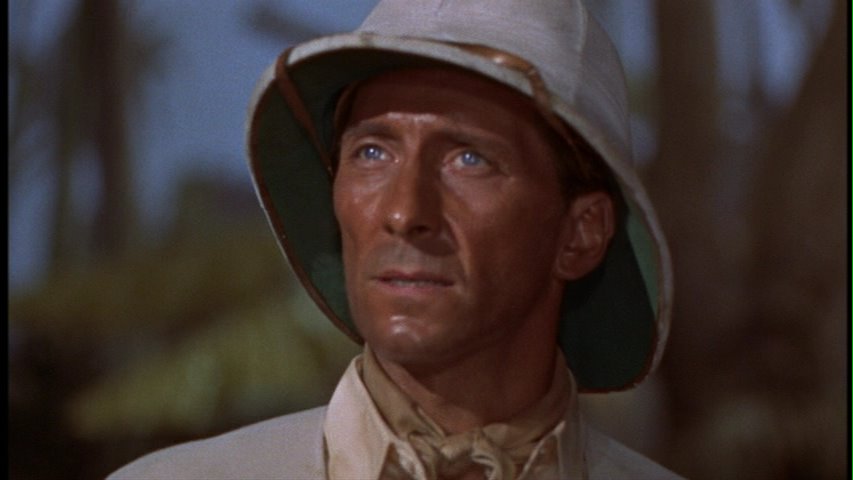
Peter Cushing


Warning: the following post is a spoiler for anyone planning to watch the 1959 version of the Mummy.

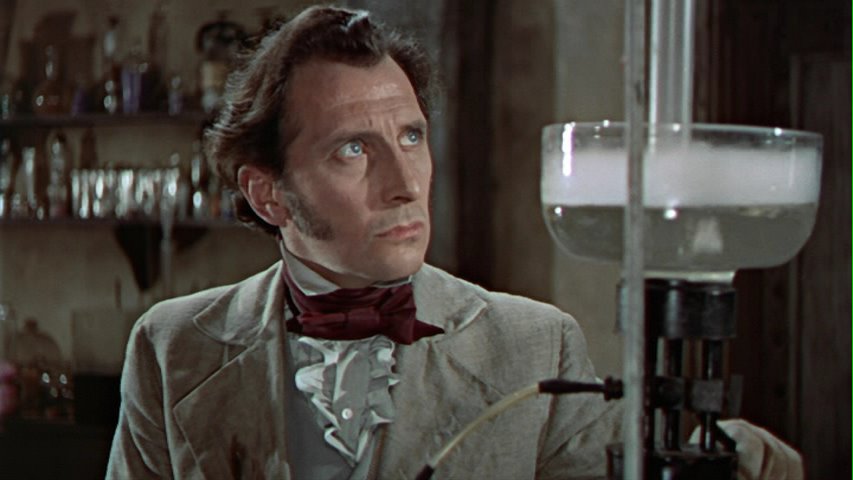
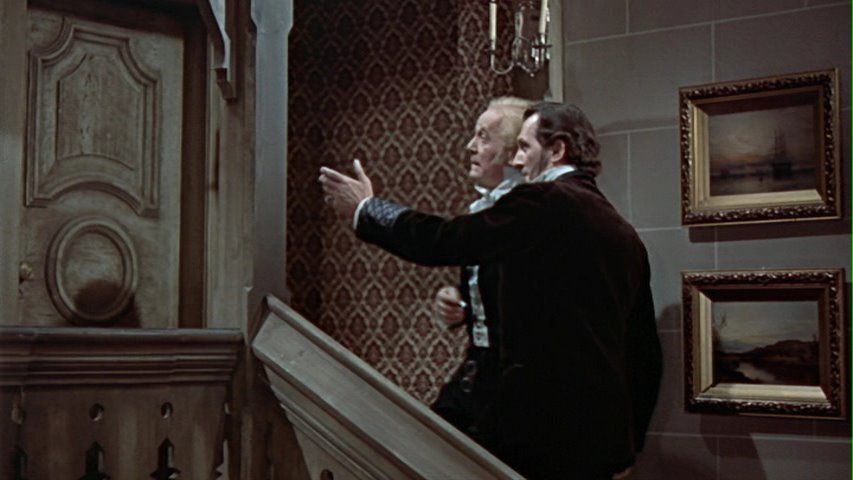
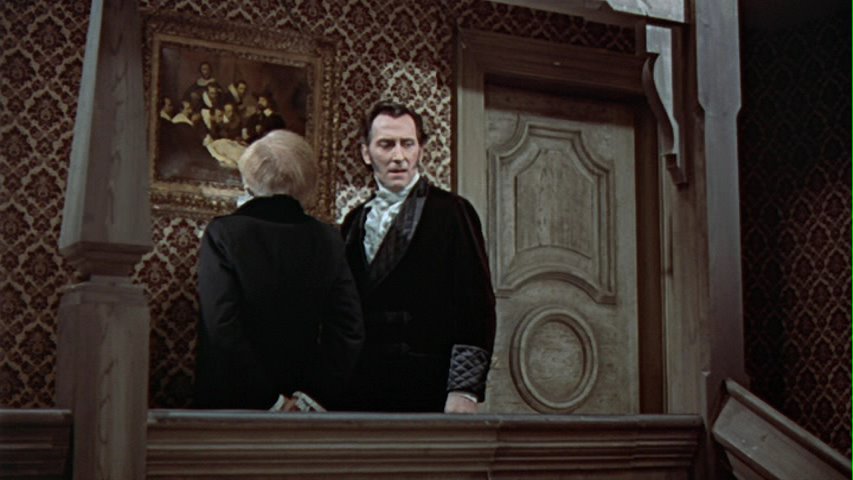
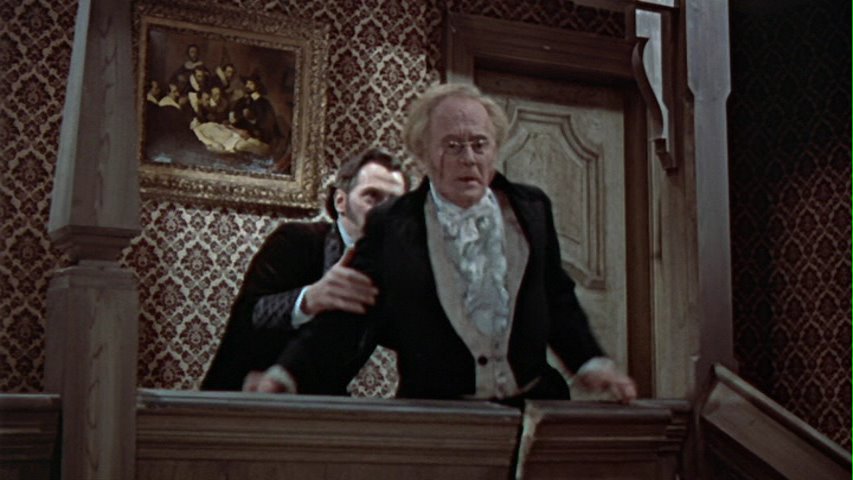
To review: Peter Cushing is the most competent Van Helsing and the cruelest Dr. Frankenstein to grace the screen. That brings us up to this installment. He’s also the greatest John Banning…ever. Remember the Bannings?

Kharis sure as hell does.

He spent a good chunk of the last century trying to hunt them down, first in Maplewood, USA and then later, in the Hammer films, at some posh neighborhood in England located conveniently near an insane asylum. I’m not sure where in England, exactly. It’s sort’ve like the village near Frankenstein’s castle – where was that exactly? The old ladies were English, the burgomaster was Prussian and the torch wielding mob, judging by their use of fire, must have been French. Viva la monster’s death!

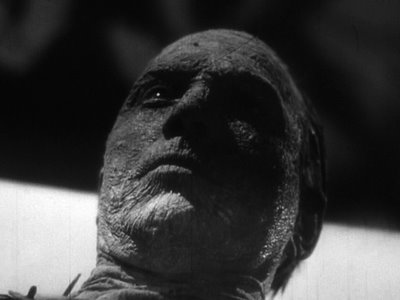
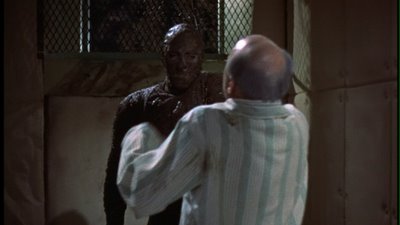
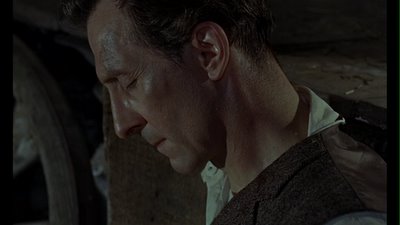
But I digress. John Banning was on the expedition, but cot ridden and nursing a broken leg when his dad, Stephen Banning, violated Ananka’s tomb and read from the Scroll of Life, thus re-activating Christopher Lee’s acting career for another 88 minutes (is that a curse? I think not!). Kharis grabbed the scroll and Stephen Banning spent the rest of his life beside himself. That is until years later, back in England, when Kharis peeled off the bars of Stephens padded room and gave the old man a good choking.
How did Kharis get to England? His handler....

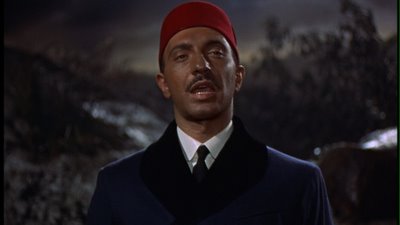
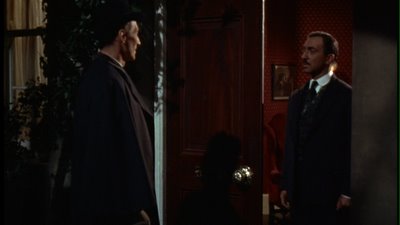
...a sith like priest in the miniscule cult of Ananka, brought him in a casket marked “relics, just some old relics…nothing more.” He moved in to John’s neighborhood. And John Banning took a little time piecing it all together (a rare case of the deniability factor for Mr. Cushing, in fact, the only one I can think of if you don’t count Star Wars), but by the time the second murder happened – to another party of the expedition, he figured it out.


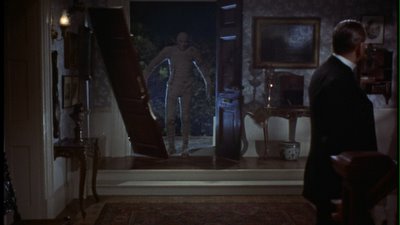
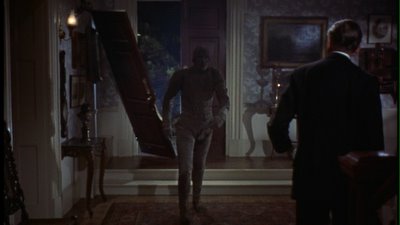
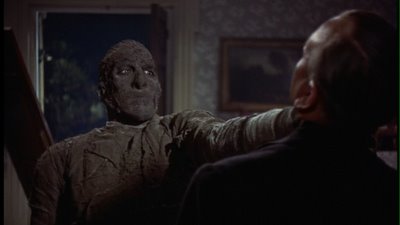
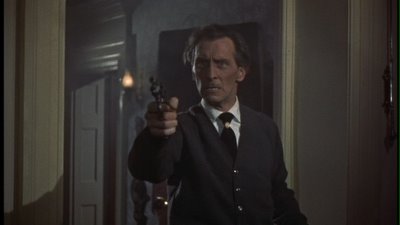
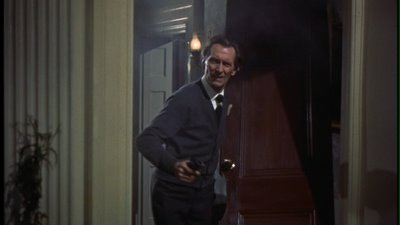
Notice how quickly Kharis gets from point A to point B. Like a man with a purpose. The Universal Kharis was often laughably slow. Not the Hammer mummy. Christopher Lee lumbers onward, straight to his prey. But he cannot multitask – and though the next night’s victim is there in the room, Kharis returns to his master. John fires his pistol….
But the monster still moves?
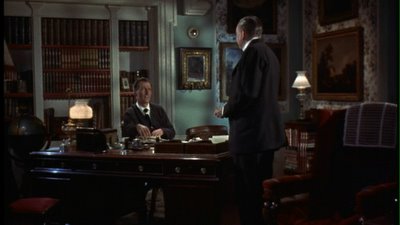
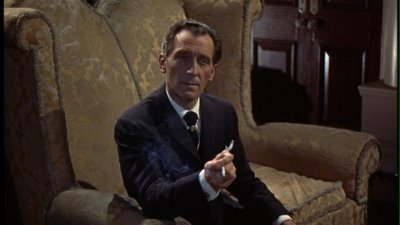
Peter Cushing is a master of props. In fact, one of his nicknames was Peter Props. He could fiddle with something or smoke a cigarette in a manner that seemed effortless and natural. He doesn’t come off as too self aware as most of the later method actors do. Personally, I like my Peter Cushing in a Victorian study with a glass of brandy and a gun cabinet. Which is why I like The Mummy.
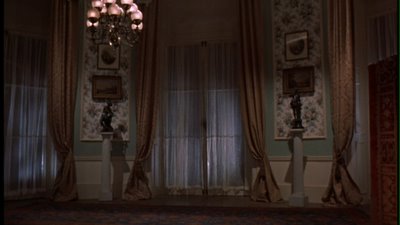
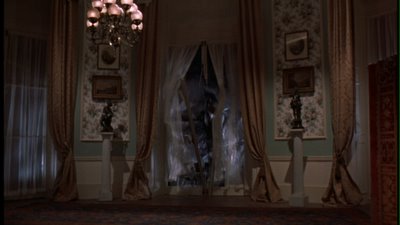
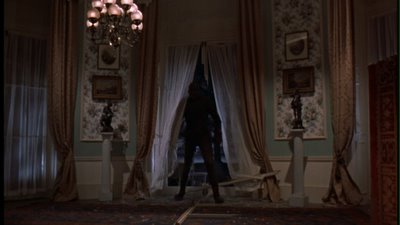
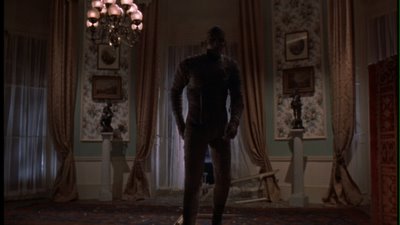
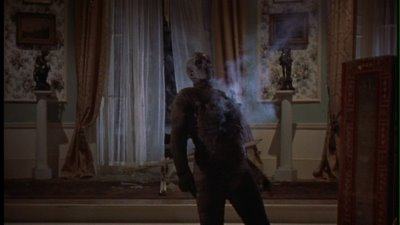
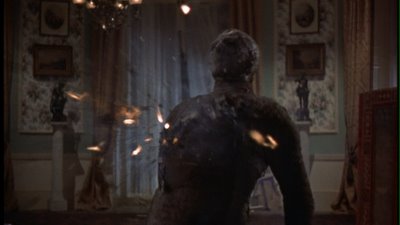
In most horror or sci-fi films, the bad guy or creature starts off in the film as being completely invulnerable and often excessively powerful. But two hours of a bad movie can drain the energy from anything and towards the end, the hero faces a drastically weakened creature, though presumably nothing has changed. The result is that the finale is often something that wasn’t remotely plausible at the beginning of the picture. That doesn’t happen in The Mummy. Kharis busts through the french doors of John Bannings study as quickly as he tore open the bars of his dad’s cell, and broke down the front door to get that other guy. Kharis is still quite unstoppable. But, when its John’s turn to die, he keeps his cool and does everything in his power to slow Kharis down – perhaps the fractions of a second will allow an opportunity to present itself.
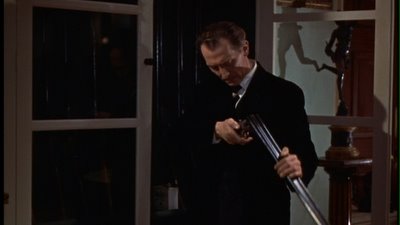
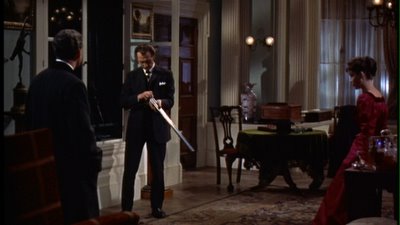
First, he blasts him twice with the shotgun

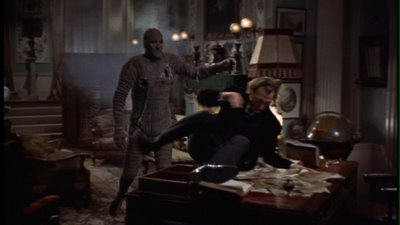
Kharis is still unstoppable - forcing John to strategically redeploy over his desk.

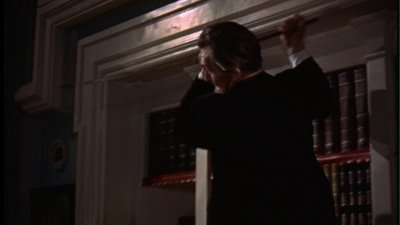
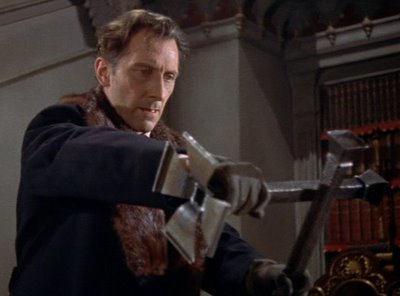
Peter Props makes excellent use of a harpoon.

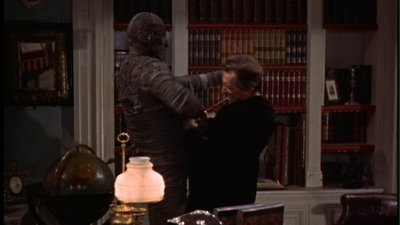
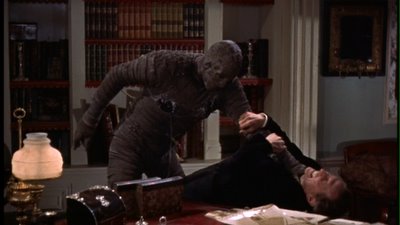
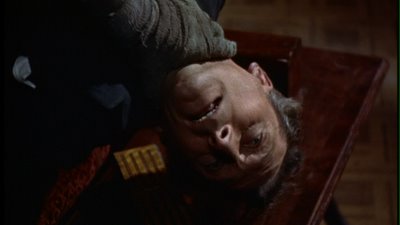
Yet, the bastard mummy is still unstoppable.Until the opportunity stumbles in.


It never hurts if your wife is the spitting image of queen Ananka, which is why I added that to my eHarmony wish list.

Now most fellows would still be crapping in their britches after such a near death experience. But not John Banning. He goes to handler's house (once he figures where it is…just down the street)
and craps on his religion instead – in a gentlemanly way, of course.
Which sets up a finale with more of this:
And more of this:
And this:
The film has several weak spots in the script, but because of Terence Fisher's direction and the cast, particularly Peter Cushing, it weathers past those and is thoroughly entertaining.

I haven't had a chance to watch the hearings

But I imagine this Protein Wisdom summary of Biden v Alito seems likely.

Tuesday, January 10, 2006

The People’s government simply cannot understand freedom

A meeting between Chinese and Japanese diplomats in Beijing on Monday made
little headway in resolving bilateral issues….

Hmm, I wonder what’s getting in the way this time: Koizumi at Yasukuni again? Did a Chinese actress portray another Japanese lady in a glossy American movie? Perhaps some salaryman was overheard disparaging the character of a Chinese person?

"….with discussion instead focusing on whether Japan should put a muzzle on the
nation's news media.”

And then the Chinese foreign minister, presumably with a straight face, asks:

"Why does the Japanese media only focus on the negative aspects of China?" asked
Cui Tiankai, director-general of Asian affairs at the Chinese foreign ministry,
according to Japanese officials present at the meeting.

The obvious Chinese solution:

"In order to produce good coverage, the government in China provides guidance to
the media. The Japanese government should provide similar guidance," Cui said.

And with help from Microsoft and Google, such "guidance" has never been easier!

Incidentally, you’d be hard pressed to find much in the way of positive news about Japan in the Chinese papers. But that's different, since Japan is evil, right?

The laughs don’t stop there. The story ends with one Chinese official lamenting:

"While we have built up a mature relationship with the United States, it is
regrettable that we cannot do the same with our neighbor, Japan."

That is a pity, but one that's easily remedied. Simply act like an adult. Problem solved.

So much for the Chinese national pastime

It's true that the Chinese treat their country like it's one big baseball diamond. Next thing you know, public defecation will be outlawed.

Monday, January 09, 2006

Alas, this came too late to help me sue Edward Copeland for commenting anonymously on this blog

Because Liverputty strives to adhere to the law, I urge all members to change their handles to their birth names. I prefer to be annoying in a manner that is both safe and legal.

What do you bet he’s got a little extra patience he’s not telling us about?

Believe it or not, it's that time again...time for El Baradei to make he's periodic "we're running out of patience" remark. This time, though, he means it! Don't you roll your eyes at him if you know what's good for you!

Sunday, January 08, 2006

It truly sucks that DeLay is stepping down

bulldog on Ankle Biting Pundits is right, DeLay did the right thing. However, my crystal ball says that congress will end up doing the wrong thing in response to Abramoff. Instead of setting rules at the source of the problem, such as controlling how pork is included into bills & stuff like that, they will choose to make more ethics rules that will do nothing but create the impression of reform - McCain/Feingold style.

Stephen Hayes on the mountain of unexplored intelligence

Summary: About 50,000 of 2 million items have been analyzed. From the material that has been looked at, we've learned that between 1999 & 2002, elite Iraqi military units trained an estimated 8 thousand islamic terrorists. The group assigned to this material is understaffed and still hasn't been able to set up a good system to vet everything. A congressman from Michigan, Pete Hoekstra, has been trying for weeks to get some documents, but to no avail. Some want the material to be declassified entirely. The administration is hesitant because it's afraid the press will cherry pick materials to undercut the war effort. As for pooling more resources into ciphering the material, the Administration is choosing instead to those resources in analyzing data for current and future threats.

Friday, January 06, 2006

Sharon Dies

Ehud Olmert has some big shoes to fill. I hope he can carry on the vision. (via Drudge)

UPDATE: he's not dead - perhaps in stable condition. Oi.

Thursday, January 05, 2006

Two Constitutional Law professors discuss impeachment

On one side is Hugh Hewitt and on the other is Professor Rosa Brooks. Guess which one knows what they are talking about.


I’ve noticed that the pro-impeachment crowd has consistently tried to assert their “reality community” bona-fides by disclaiming that ‘sure, Bush won’t be impeached because the GOP has congress’, yet, they betray their sense of reality by thinking impeachment would be ideal in the first place. Here’s a rule of thumb: if you think Bush qualifies for impeachment, you have an acute case of Bush Derangement Syndrome. Take 2 chill pills a day and spend less time in the fever swamp.

Godspeed, Sharon. Here's praying for your recovery

No kidding

Prime Minister Junichiro Koizumi criticized China and South Korea during his New
Year's news conference Wednesday, claiming it is Beijing and Seoul, not Tokyo,
that should work to resolve their long-standing gripes over his repeated visits
to Yasukuni Shrine.

Read down the story a bit, and you get to the source of the problem:

Koizumi described his decision to continue his shrine visits as "a matter of the
heart" that should not be interfered with by anyone who respects
freedom of thought
.

Well, that leaves out the People's Party.

Monday, January 02, 2006

Peter Cushing

Dr. Frankenstein, as played by Colin Clive in the Universal Pictures, is, relatively speaking, a sympathetic character. Sure, he was driven to madness and obsession, but that’s just because he was a victim of his own genius. Ultimately, we expect him to repent or somehow correct himself. He spends much of his time in the second Frankenstein regretting his madness in the first Frankenstein – and who could blame him? After all, he’s torn between his science and his angelic wife.

Peter Cushing’s Doctor/Baron carries no such baggage. He’s not some promising fellow who’s led astray by his own brilliance. Rather, his whole being is geared towards the dark path. His course is steady and sure. Like Hwang Woo-suk, the Doctor/Baron is not satisfied patching together monster puppies.


If Woo-suk is all show and no science, then the vain Doctor/Baron is all science and no show. Right after the creation of the monster puppy, we see the Baron’s partner excited about sharing the good news with the scientific community.

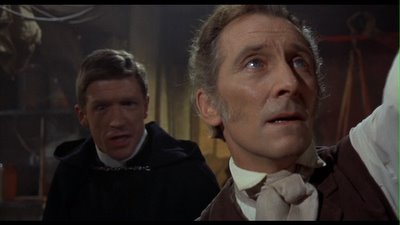
Notice the calm in the Doctor/Baron’s demeanor. He has no intention of sharing their breakthrough with others. His purpose from the get-go was to create a man, as cursed and damned as you ever saw. His partner is horrified and refuses to take part, but that doesn’t stop the Doctor/Baron from proceeding, getting parts by hook or crook or sometimes……murder.

He was going after that fella’s brain – which brings up a curious oversight. If you were after the professor’s noodle, then why kill him in a way that would smash the skull? Nevertheless, Peter Cushing plays the coldest most ruthless Frankenstein ever. He never frets about what he is doing or what he has done – but he’s always thinking about how to move forward.


Notice how the local religious authority is outraged and confronting the doctor, yet the doctor is too busy with his work to pay him any mind.


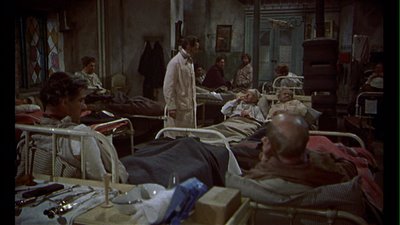
Even when he creates a hospital for the poor in Revenge of Frankenstein, his purpose remains singular – to create another man. The destitute patients merely provide a front for his nefarious activities, as well as a 24 hour pull-o-part.

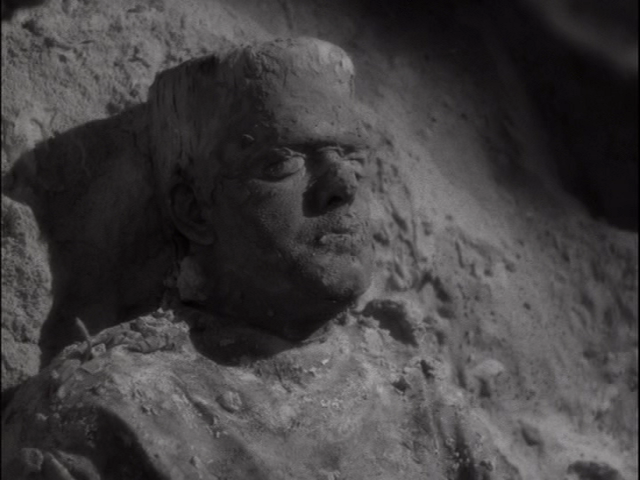
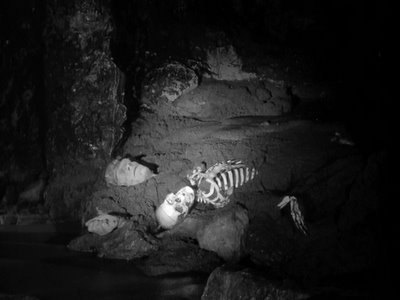
When Hammer Studios first planned on making a Frankenstein picture, Universal would not allow them to use it's Karloff styled monster. As a result, The Curse of Frankenstein is a big departure from the Universal brand. If you recall, the Universal monster was quite indestructible. Sure, all the Universal freak stars had their hand at playing him, but it was still the same monster - so much so that it assumed the title name. And some of the conditions in which the monster was destroyed and yet preserved, were pretty horrendous. For instance:

the sulfur pit-


in ice (more than once)-


sewage-


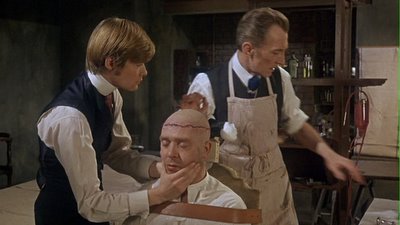
In short, it sucks to be him. In contrast, Peter Cushing works on his monsters like a mechanic works on so many cars:

Remember the classic 57’ Lee with the black top and the variegated eyeballs?

Or the 1969 Pravda with the removable hard top and racing lobotomy scar?

My favorite was the 67’ Denburg with the sexy curves and the 5 liter ta-tas.
What a ride!

In the Universal pictures, the monster is the chief menace, even if it is sympathetic. In the Hammer films, the Doctor/Baron is the real bad guy and there’s nothing sympathetic about him. True, the monsters kill a person or two in each of the Hammer films, but Peter Cushing is usually responsible for worse. Terence Fisher more or less reconciled this difference between monster and doctor in the second movie by simply making the Doctor/Baron the monster.

Dr. Frank will see you now.

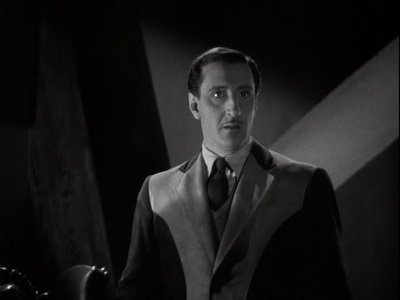
The one Hammer flick that's the black sheep of the bunch is 1964’s The Evil of Frankenstein. It does not carry on from its Hammer predecessors, but more or less takes up where the 1932 Universal film leaves off – though the story borrows generously from the Son of Frankenstein. Only, with less of Rathbone’s nervousness

and more of Cushing’s sly confidence.
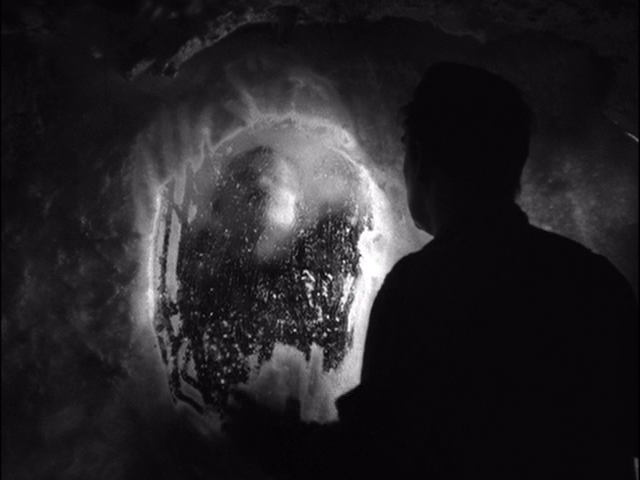
In true Universal fashion, the monster is like a re-heatable snack, recovered, yet again, from the ice. Tupperware is still trying to find the Doctor’s secret. (Incidentally, The Evil of Frankenstein may not be held in high esteem, but there's an excellent sequence when the Doctor/Baron recounts when he first created the monster.)

But mostly, the Hammer films tend to downplay the supernatural, indestructable elements. In that light, the Doctor/Baron’s meglamania has no larger evil to redeem himself against – making him more controlling and vile than if he had. And Peter Cushing brilliantly seizes on that.

From Japan: Ex-abductees ID N. Korean agents

Turns out it's the Iranian president.

Bush defines intercepts as 'limited'

I'm so glad that's cleared up. Now we can move on to the next bogus scandal - Cheney absconded with church funds, or Rove ran off with a Senator's wife... I like to think Bush killed a man, it's the romantic in me.

Saturday, December 31, 2005

I don’t even like the Left and this was still troubling….

A recently unearthed letter from Upton Sinclair reveals that he knew, prior to publishing Boston, that Sacco and Vanzetti were actually guilty. That’s according to conversations he had with their lawyer. Sinclair struggled with his obligation to tell the truth – and then proceeded to keep the secret beyond his grave.

Next thing you know, it’ll turn out that there weren’t bits of people being ground into hamburger meat.

Friday, December 30, 2005

Sometimes it’s best to run roughshod over the opposition….

In Kanryo, a fascinating book about Japan’s bureaucracy, journalist Tadahide Ikuta laments that the strong political leadership that would be needed to reform these entrenched agencies simply did not exist. That was true in the mid nineties, when the book was written, but, thanks to Koizumi, times have changed. Here’s a summary of Koizumi’s resolve and tactics in dissolving the lower house and getting his Postal reform passed. Notice how many nervous nellies and political opponents he had to stiff-arm to see it through.

VDH takes it to the hole

The gist: Mr. Hanson asks - why are DNC leaders bitching and moaning so loudly? Mr. Hanson answers - because we're winning the war. Good stuff.

Thursday, December 29, 2005

The country formerly known as Burma continues to play hell with map makers

Is the Burmese government’s relocation of the capital to another area of the country a reflection of a new center of power? Apparently not:

The decision to shift the government of Myanmar (Burma) to a mountainous inland
hideaway has flabbergasted the world--and the military regime's government
workers.
Perhaps the new locale was chosen because of its convenience and comfort?

It's [Pyinmana] … prone to malaria, full of poisonous snakes and generally a
miserable backwater. No one understands why anyone would choose to move there.

Well, no doubt, the government planned the relocation well and will have everything set up for the arriving government workers, right?

…. When they arrived, they found there were no apartments built yet, so
they are sleeping at their offices. They eat meals prepared by co-workers.

Fortunately, the current government workers can choose to leave their posts so they can stay with their families and choose to join the private sector. Psych!

By law, government officials cannot resign without permission--which is not
often granted.

Sounds like the government is trying to make itself less accessible to the people.

Wednesday, December 28, 2005

Let's give a shout out to our Polish allies

The reality community holds these assertions to be self evident

The Mao’s little red book hoax reminds me of a similar fake-but-accurate story a few years ago at UCO where a middle eastern student was told by immigration officials that he/she (the gender changed with the telling) would have to give up Islam and convert to Christianity to become a citizen. It never happened, but I’m sure the myth lives on. In this case, Ted Kennedy is more than happy to keep the belief alive.

Tuesday, December 27, 2005

Peter Cushing

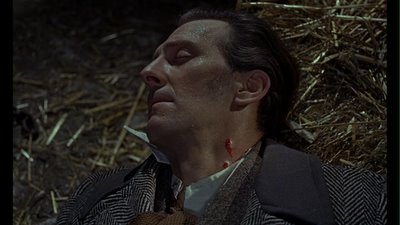
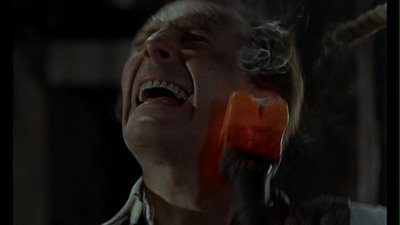
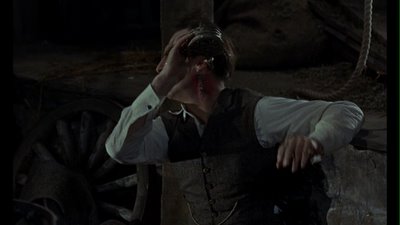
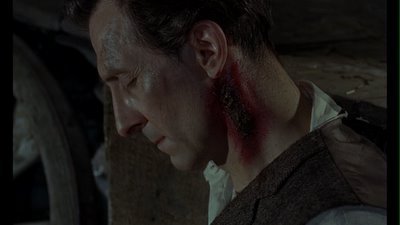
If there was a vampire lurking about, snatching pretty girls in the neighborhood and tossing aside their bloodless husks, this is the Van Helsing I’d want on the case.


His best quality? His main strength as a vampire killer? He’s able to take command of the situation – always. He stays calm and he thinks and you never see him lose his nerve. He’s a man of action, but he’s also book learned. He tends to create the opportunities to turn tragedies into successes.

Ever wonder what you should do if you got bit? Follow and learn:
First, heat an iron –

Then sear the bite thoroughly –

Dowse generously with holy water –
Wait – Heaven takes care of the rest –

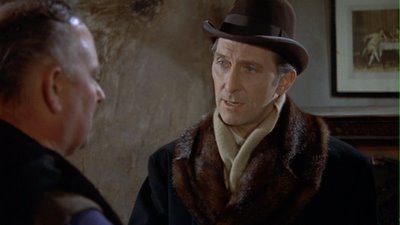
He enters a room without hesitation – though he's mindful of the danger. I’m not sure where his confidence comes from since he never seems foolhardly or reckless. Quite the contrary, he’s inquisitive and direct, as here, where he deduces the fears of the local innkeeper right in front of him – tells him he knows what they are afraid of and that he knows it is evil:
And when it’s time to confront evil, face to face, his steely nerves allow him to act unassuming and casual. Because he knows the vampire is not an athiest.

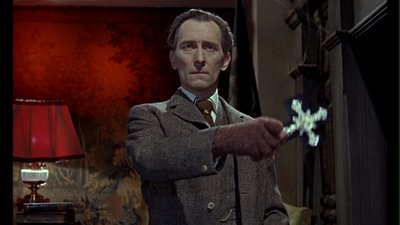
And you can always count on a good finish, as in Brides of Dracula, where Cushing turns a windmill into a crucifix.


Stills from the Horror of Dracula and The Brides of Dracula.

China prefers no reform at the UN

Vice-Foreign Minister Qiao Zonghuai Monday reiterated China's position in the
reform of the United Nations (UN), saying "priority (of the reform) should be
given to increasing the representation of developing countries especially
African countries."

Translation: the 2nd largest economy in the world should not be on the security council.

Monday, December 26, 2005

Is Newsweek even trying anymore?

Arlene Getz wants to know where the outrage is regarding the NSA story. The answer: in newsrooms across America and few other places. She goes off on a ridiculous parallel between the U.S. and S. Africa that would embarrass any person living north of the Bush Fever Line:

Back in the 1980s, when I was living in Johannesburg and reporting on apartheid
South Africa, a white neighbor proffered a tasteless confession. She was "quite
relieved," she told me, that new media restrictions prohibited our reporting on
government repression. No matter that Pretoria was detaining tens of thousands
of people without real evidence of wrongdoing. No matter that many of them,
including children, were being tortured—sometimes to death. No matter that
government hit squads were killing political opponents. No matter that police
were shooting into crowds of black civilians protesting against their
disenfranchisement. "It's so nice," confided my neighbor, "not to open the
papers and read all that bad news."

Yes, the comparisons are obvious, aren’t they? But the manure doesn’t stop there. Getz describes Desmond Tutu’s reaction – not to the spy story, but to the 2004 election?

Tutu recalled teaching in Jacksonville, Fla., when Bush won re-election in 2004.
"I was shocked," he said, "because I had naively believed all these many years
that Americans genuinely believed in freedom of speech. [But I] discovered there
that when you made an utterance that was remotely contrary to what the White
House was saying, then they attacked you.

I know I’ve been living in the Bush bubble, but what is the Tutu talking about and what does the 2004 election have to do with anything?

Saturday, December 24, 2005

Friday, December 23, 2005

This is about right

And there's more Lileks here from the Hewitt show. Lileks makes the following observation:

"...the people who are worried about civil liberties in this case, being somebody from Karachi calling somebody in San Diego and telling them where to plant the little nasty sticks. That's one level of civil rights violation, if it is. The other level of civil rights violation is martial law, because Washington has been taken out, and we have to take our orders from somebody in a NORAD bunker deep in the southwest. And you want to see civil rights violations, you ain't seen nothing yet."

Scroll down on Radio Blogger to see the Thursday Mark Steyn segment - where he discusses the House of Lords, aka the Senate.

Tuesday, December 20, 2005

If it looks like treason, smells like treason and acts like treason….

then it must be something we should not question. To me, at least, it seems clear that the liberal death star laid down some suppressing fire to give Democrats cover while they killed the Patriot Act. There are other possibilities for the timing of the NSA spy story: they could’ve used it to drown out the Iraqi elections or simply to coincide with the author’s book. Maybe the editors felt they had a damning story that they could release at an opportune moment. Perhaps a combination of all those. One thing is certain: it ain’t news and no matter how you feel about the program – legitimate scandal or a bunch of hooey – national security interests were the editors' least concern.

Another thing is certain: this president can’t fart sideways without his opponents screaming that he’s stifling debate or lashing out. It’s not every day that Newsweek sounds as unhinged and hysterical as kos or nonfamous.

UPDATE: This is a house of cards. Drudge did a little spade work and found executive orders from Clinton and Carter authorizing warrantless searches and surveillance. I, for one, have never been as impressed with Carter as in this instance. And here's Andrew McCarthy's take. Make no mistake, Democrats will proceed with the rhetoric of fear.

Meanwhile: Hugh Hewitt had Jonathan Alter, the writer of the Snoopgate piece, on his show. You can see a transcript of the interview here.

And finally - goodbye.

Sunday, December 18, 2005

It's about his sche-du-al....

Honestly, does a week go by when Biden isn't on Meet the Press or Face the Nation? I just switched on the boob tube and there he was again - I call it the Sunday Sermon. He and McCain have some sort've tag team going on.

Thursday, December 15, 2005

Ted Rall should be this clever....

via Ace of Spades

Freedom on the march

The Iraqi's have been able to voice their opinion so much this year that this vote almost seems like old news. What a great thing. Anyway, Iraq the Model has been posting extensively on it. Also, Pajamas Media is on the beat.

UPDATE: Since I didn't brave the car bombs to cast an Iraqi ballot, I feel like dying my finger purple is not the best way to show my support. However, what better way to express support and confidence with the Iraqi people than buying dinars? It's a win-win: you're telling them that you believe the economy is going to boom, and when it does, you stand to make a killing - though not in the self whacking sense. Just be sure that the bills are legit (i.e. - no Saddam picture).

Tuesday, December 13, 2005

Israel's going to need a bigger fence

Abbas is giving money to relatives of suicide bombers, former Israeli settlements are now being used as terror camps, the Iranian loon wants Israel to move to Europe, lock, stock and barrel….or be destroyed or preferrably both. And it’s a small wonder that the UN doesn’t care for Israelis – they, too, don't even think they should exist.

Lileks has a 2005 year in review that will be funny to some, real to others

Monday, December 12, 2005

Gateway Pundit also has comprehensive coverage of the Iraqi elections

so far. Lots of stuff on Iraq, Australia & China - just keep scrolling.

Gateway pundit has the most complete coverage

of the People's Government crackdown on the People - that I've seen, at least.

Saturday, December 10, 2005

One of the great ones dies

Richard Pryor died of a heart-attack at 65.

Friday, December 09, 2005

The Iranian nuke situation may escalate into discussions....

According to the BBC headline, El Baradei warned that the world is losing patience with Iran. That's pretty meaningless left on it's own, but after reading the story, he's never even quoted as saying that. Instead (and perhaps this is the result of lost patience) the story says:

Mr ElBaradei said European negotiators should continue talking to Iran.

"The parties need to sit together, discuss their grievances and reach a solution," he said.

"If we can do that without escalating the problem, all the much better."

Give that man a Nobel Prize!

Stop the NYTimes presses: Tax cuts work!

Here's an impressive graph. And the House is working on more tax cuts. Notice that the Krugman cat index hasn't been updated in a while - perhaps because the puss is orbiting beyond the range.

Thursday, December 08, 2005

While it's important to remember December 7th

It's also important to remember the years that followed. I believe the photo is of the USS Pennsylvania, followed by the Colorado moving towards the Philippines, 1945.

Tuesday, December 06, 2005

Monday, December 05, 2005

Rumsfeld delivers a stellar speech on Iraq

"the idea that we're going to win the war in Iraq is an idea which is just plain wrong..."

Dean:
"I've seen this before in my life. This is the same situation we had in Vietnam. Everybody then kept saying, 'just another year, just stay the course, we'll have a victory.' Well, we didn't have a victory, and this policy cost the lives of an additional 25,000 troops because we were too stubborn to recognize what was happening."

"I think we need a strategic redeployment over a period of two years," Dean said. "Bring the 80,000 National Guard and Reserve troops home immediately. They don't belong in a conflict like this anyway. We ought to have a redeployment to Afghanistan of 20,000 troops, we don't have enough troops to do the job there and its a place where we are welcome. And we need a force in the Middle East, not in Iraq but in a friendly neighboring country to fight (terrorist leader Musab) Zarqawi, who came to Iraq after this invasion. We've got to get the target off the backs of American troops."

Note to GOP: Dean just handed you the stick, now beat him over the head with it. We'll see how many of the Democrats in Congress side with him over the President.

LDP wants to allow Internet campaigning

A wake-up call for who?

Here’s a curiously incoherent piece by Fareed Zakaria. Summation: China is using soft power to out-charm us, but they’re not really that charming, but it’s working anyway and the U.S. is missing the boat by not being invited to the upcoming Asian summit that was designed by China to leave us uninvited, though this year we did receive an open invitation from China though we’re not going. Still with him? He goes on: the region resents American involvement in the region to counteract Chinese power…I mean soft power…though they are now realizing that Chinese power…I mean soft power….isn’t in the region’s interest so they expanded participation in the summit to Australia, New Zealand and India…and the U.S., which is still not going. And the above countries don’t share U.S. interests so our interests will not be represented? Oh yeah, and anti-Americanism is rampant all over Asia, including, Zakaria tells us, Japan. According to Zakaria, an Asian government with close alliances to the U.S. is at a political disadvantage if there be voting in that country…

To believe that last statement, you’d have to disregard the pro-American leaders recently voted in by the people in places like Indonesia, Australia, Mongolia and…Japan. And I’d bet that the Taiwanese people feel safer and freer under the U.S. military than that of China. And if push came to shove, I would bet on the S. Koreans to come to their senses and side with the U.S. instead of China. And if the Burmese could decide for themselves, little doubt they’d cling to the U.S. over their own autocracy or China’s.

Zakaria, like most other Newsweek and Time reporters, apparently believes that overly hedging your bets is the best way to create an aura of objectivity. As in a recent piece of his where hs was saying that China is a growing threat, war might be on the horizon, but then again it’s unlikely, but there are ominous clouds nonetheless. Does the future belong to China? Maybe, maybe not. What’s the point? The problem is that by layering caveat over caveat, Zakaria convolutes everything until his article is practically meaningless.

If you dig down deep enough in his current article to hit the thin vein of logic therein, that the U.S. needs to pay more attention to Asia as a whole, then you’ve reached a conclusion the that Bush Administration reached quite some time ago. Zakaria laments that everyone in Washington is too dense to know that the charming/uncharming China is out-charming/uncharming us…but hold on there, Fareed! Bush just got back from the region where he tried to put a focus on American relations to the region. Bush deftly criticized China’s human rights record and encouraged reform there as well. He also did so through other countries in the region, and behind the cameras, Rice was doing the same. Bush was the first president ever to visit Mongolia – an ally on the war on terror and a country that worries about its southern neighbor. Bush’s message was comprehensive, dynamic and forward looking – touching on increasing freedom, reforming government, taking care of health crises and improving trade, etc. The press, of which Zakaria is a member, had little interest in Bush’s message. I happened to watch much of Bush’s visit on Japanese television & it seemed that every time an English speaking journalist opened his/her mouth it was to ask about Iraq or prison abuse or the Mertha deal – just to let you know what they consider the pressing issue to be. True enough, Iraq has occupied much of the President's time. Yet, he still has not forgotten about all the things that the press has forgotten: Afghanistan, trade issues everywhere, bird flu (though if that can be used against the President, they’ll quickly remember), Taiwan, etc. It’s true that Zakaria has been warning about Chinese power for years, but when he frets that there is nobody in Washington to define the long term American role in Asia, he betrays his bias against the President who has been defining that very role since his first day in office. Perhaps the wake up Zakaria seeks is for his own colleagues.

Friday, December 02, 2005

Squirrel padawons

I'm not sure if the squirrels that killed the dog in Russia were Syth lords, or not

Thursday, November 24, 2005

Happy Thanksgiving

This is not really a Thanksgiving post, but I will say that I'm thankful to live in a country where the net sum of our national heroes are not just celebrated in the U.S., but in other countries as well - as this statue of Commodore Perry located in the Japanese port city of Hakodote demontrates.

I had a great time in Japan, but the trip was far too short and I did not want to return. Hokkaido was pretty cold at times, but the weather wasn't too bad. Sapporo is a tiny town (about 1.5 million) compared to the mega city that is Tokyo. It's also pretty new, which means it had a easy to navigate grid structure to the roads. Highlights? The fish and crabs were plentiful and tasty as was the beer and sake. My tongue is not so acute as to notice the difference between fish in Hokkaido and fish in the Kanto area - but Tomoe's was and she was the one that marked the trip as an eating tour. Hokkaido is also known for dairy products and chocolate and lamb. Not things you normally associate with Japan. The milk was exceedingly delicious and I made sure to have some every morning with our lunch buffet. Through the miracle of Japanese cuisine, I stuffed myself repeatedly and still lost weight.

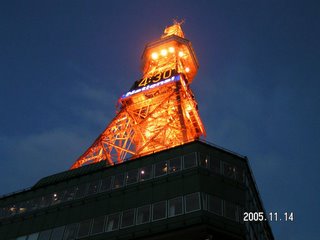
Sapporo has a lot of western influences in the architecture. I wish I'd taken more photos of some of the government buildings and Christian churches. Regardless, there were several picturesque landmarks such as this TV tower.

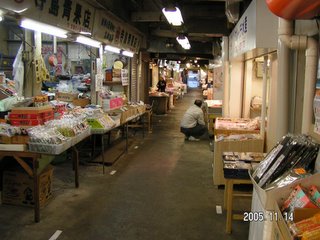
But you can't go to Sapporo without visiting the fish markets. Oddly, a place like the fish market below has no fish smell and a floor almost clean enough to lick - only in Japan.


Within that market were little sushi stalls.


Check out the generous serving of salmon!


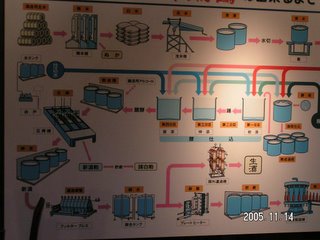
I didn't get any pictures of the breweries there, but here's a diagram of the sake making process found at the Sake Musuem (which was not really a museum so much as a store).


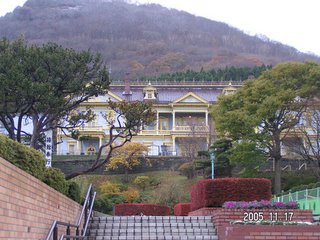
Hokodate is a much smaller town towards the southern tip of Hokkaido - but well worth a visit because of a lot of little museums, convenient street cars and historic buildings (again, with a western influence) like this government building


Not the best of pictures, but you get the idea. There's also the Goryaku, a large western style fort built at the time of the Meiji revolution (1860s) - which we did not have time to visit. Photo from this site.


We took a tour of the harbor and I was pleased to see signs of Japanese military vessels like this destroyer.


And this Coast Guard vessel, which, according to the guide on the ship, routinely plays cat and mouse with N. Korean vessels in the area. This is actually the larger of two vessels which lends helicopter support to the smaller one (not shown).


The rest of the trip was spent in Tokyo & unfortunately I didn't get very many sightseeing pictures from there. But I did get plenty of photos of Tomoe's two nephews - who where not the least bit afraid of the ugly pink-skinned monster.


Sunday, November 13, 2005

I`ve been in Japan for the past few days

and have had little inclination to navigate a Japanese keyboard to post - until now. My jet lag has me up early in the morning waiting for Toe to get up. We`re currently in Hokkaido and trying to decide which brewery to tour. I favor the Sapporo brewery where you can cap the tour off with a variety of fresh Sapporo beers and all the Genghis Kahn style barbecue mutton you can stuff down your pie hole. Toe wants to go to the Kirin brewery, which offers a sushi buffet. Sushi has been the main part of every meal here thus far. Perhaps we`ll make it to a ramen place, but I doubt it will be today.

Friday, November 04, 2005

With a density reminiscent of Dan Rather, Kristoff more or less makes a correction

“First, he denies that he stated that the Vice President's office, not the
CIA, sent Ambassador Wilson to Niger, only that Cheney wanted an investigation
by somebody. But Kristof admits: 'In fairness, though, it is true that Cheney
apparently didn't know that Wilson had been dispatched. If I'd known that I
would have said so.'

"Then he turns to the matter of his column reporting that Wilson had
actually seen (forged) documents on the uranium deal, when he didn't. Kristof
explains: 'Wilson has said that he misspoke when he made references to the
documents to me and to two other journalists.'

“'But it does seem to be true that Wilson claims to have debunked the Niger
deal more firmly than some people remember him debunking it.'”

Translation – Wilson debunked nothing. Close enough, though, for the NYTimes.

Ramadan celebrations spread beyond Paris, beyond Ramadan

Instapundit has a pretty good roundup on riot posts. Drudge has a report that the riots appear to have been planned, according to the French Interior Minister. Hmm. LGF remembers a call to action from an Algerian Islamist organization back in September. (Now why would "French youths" care about an infitada?) Mr. Johnson also relays a report about a disabled woman lit on fire. Thus far, French authorities do not believe Eminem is involved.

A good day for the Alaskan carribou

they're one step closer to getting some relief from ANWR mesquitos.

Thursday, November 03, 2005

Ramadan festivities continue in Paris

Gateway Pundit has a good roundup. Plus, Roger Simon posted a fascinating letter.

Tuesday, November 01, 2005

That was quick...

Bush's new pick has conservatives purring like kittens.

Humorous exchange between Howard Dean & Chris Matthews

Does this qualify as standing up for what you believe in?

Monday, October 31, 2005

Here’s a perfect example of the difference between Japan and China.

Whereas Japanese school boards may choose textbooks that gloss over WWII (their loss), there is nothing stopping the publication of a book strongly criticizing Japanese leaders or Japanese conduct in China. I’ve never seen a Chinese textbook, but I’d imagine that they tend to completely misrepresent the 20th century – by the command of Beijing. What’s more, no criticism of its leadership is tolerated in the publication industry at all. As the latest example, Mao: The Unknown Story has been banned in China (mentioned at the bottom of the article).

Reading the article, you can almost piece together the missing verses from the song “Imagine”

Imagine no food
No tableware or pots and pans
Nothing to masticate or digest
Except the tree bark and grass
Or the flesh of your neighbor….

Okay, I’m no songwriter, but you get the idea.

Friday, October 28, 2005

Kerry still hasn't found his voice on the war

Tim Blair noticed a Kerry-ism in an email the senator sent out to his supporters about his then upcoming “major Iraq” speech:

Later today, I will deliver a major speech on the war in Iraq.

It asks a hard and essential question: how do we bring our troops
home within a reasonable and responsible timeframe, while achieving what needs
to be achieved in Iraq?


One thing is certain. It isn’t by continuing to pursue the Bush
administration’s “stay for as long as it takes” rhetoric.


Blair: Pretentious blowhard. If “achieving what needs to be achieved in Iraq” is key, how does one avoid the requirement to “stay for as long as it takes”?

Indeed. And his speech? (excerpts here) Well, he likes to talk about asking the hard questions, but never seems to get around to the hard questions. When he finally drones his way to the "plan" portion of his argument - he provides absolutely nothing useful. He thinks there should be a political solution between the Sunnis and Shia - yet, he refuses to acknowlege that that's what all the constitution business is about. He thinks we need to build up Iraqi security, but refuses to acknowlege that that's what the U.S. has been doing. In short, any good ideas that he has are already in motion. And the meat of his plan? for Bush to provide a ....plan:
"The Administration must immediately give Congress and the American people a
detailed plan for the transfer of military and police responsibilities on a
sector by sector basis to Iraqis so the majority of our combat forces can be
withdrawn. No more shell games, no more false reports of progress, but specific
and measurable goals."

Not only is that not a plan, but it's just a bad idea. Bush's timelines are right on - transfer authority here, elect a temporary government here, develop a constitution here, etc. Those timelines are good to make known. They keep the wheel turning. That's the plan that Kerry is too blind to see. His timelines are geared towards withdrawal. Personally, I'd like to see no mention of pulling troops out - even when it is happening. If we cut our troop levels in half, best not to even acknowlege that we did it until years later. Hold those cards close to the vest. As Iraqis stand up, we'll stand down - that's as specific as you should get.

Thursday, October 27, 2005

Ugh! Miers withdraws.

I was in the pro-Miers camp and thought she should at least get her hearings. The split among conservatives was, for the most part, a healthy thing, though I fail to see how her withdrawal benefits anybody, especially Bush. You’d think his record on judicial appointees would have earned some trust. Oh, well. Throughout the debate, I thought Hugh Hewitt was exceptional in his defense of Miers. He took on pretty much everyone (including what seemed like the entire NRO staff) and bested them one by one. Too bad he wasn’t on the winning side. Apparently, the anti-Miers portion of the base will not be happy unless Bush breaks out the pole and feeds the Democrats an uber conservative nominee like a Chinese man feeds a duck. I’m prepared to support that, too. I only hope the jelly-kneed Senate is.

Wednesday, October 26, 2005

Tough negotiations between two grown-up nations results in win-win solution

Straddling the fence

"Clinton said she doesn't support a deadline for withdrawing troops from Iraq nor
does she support leaving our troops there for an open-ended period."

Sounds like a Democrat.

French treachery?

Here's a month old story about the forged Niger documents claiming that they were apparently deliberately manufactured at the behest of the French government to derail the arguments for the war.
"Italian diplomats have claimed that, by disseminating bogus documents
stating that Iraq was trying to buy low-grade "yellowcake" uranium from
Niger, France was trying to "set up" Britain and America in the hope that
when the mistake was revealed it would undermine the case for war, which it
wanted to prevent."

And yet the pith of the 16 words remains firm.

Tuesday, October 25, 2005

Another pro-American leader gets reelected

this time in Poland. When the big picture looks bright, you can weather all the nasty little bumps along the way.

Pistol Packin' Mamas providing security in Iraq

Congratulations to the Iraqis for passing their constitution!

Meanwhile, the left has the champagne on ice, waiting to celebrate 2,000 dead or Fitzmas - whichever presents itself first.

Saturday, October 22, 2005

Chinese hysteria

A recent opinion piece on the Peoples Daily Online, entitled How can Koizumi Win Trust from World? expresses how bent out of shape the Chinese are over the Prime Minister’s fifth trip to the Yakusuni shrine:
Despite the strong opposition from China and other Asian countries and their peoples as well as from the people of insight in Japan, Koizumi provoked disturbances and randomly hurt the feelings and dignity of the victimized countries and their peoples during the war and seriously undermined Sino-Japanese relations. The move evokes great indignation in Chinese people.

This year marks the 60th anniversary of the victory in China's War of Resistance against Japanese Aggression and the World Anti-Fascist War. Such a move challenges the human conscience and international justice.

In April this year, Chinese President
Hu Jintao put forward a five-point proposal on the Sino-Japanese relations at the Asian-African summit. Koizumi's action ignored the sincere wishes of the Chinese government and people for improving the Sino-Japanese ties...

This 5 Point Plan should not be confused with Jintao’s 5 Point Plan aimed at improving relations with Thailand, or the 5 Point Plan on how to handle the Middle East, or the 5 Point Plan to improve relations with India or the 4 Point Plan in dealing with Taiwan. Was that last plan missing a Point? Indeed it was, but not to worry, there was also a 5 Point anti-secession law that was passed this year and another 5 Point proposal for relations between the KMT and the People’s government. That’s 14 Points towards Taiwan alone, if you’re keeping score. But those aren’t freedom leaning Wilsonian points. One might assume that Hu’s 5 Points issue resolution schematic extends to other areas as well:

5 Point Strategy to oppressing religious minorities,
5 Point Strategy to establishing an obedient press,
5 Point Strategy to defending Tinnamen Square from freedom,

maybe you could throw in…

5 Point Strategy to increasing fireworks production in elementary school factories,

or, closer to the boudoir….

4 Point Strategy to pleasing Mrs. Hu (the fifth point banned by the one child policy).

If Hu were to team up with a big name publisher, his 5 Point strategies could replace all the 8 Step strategies currently in the Diplomatic self-help section of your local Borders.

Adopting a numerically consistent method to solve issues is fine, in itself. The unavoidable generic and vague types of steps like “…economic and trade cooperation should be expanded” say little, but may help keep the eye on the ball. Yet, it hardly represents a great vision forward. And when you don’t respect those basic generic principles in the first place, it fails to mean anything at all. Going back to Japan, check out Hu’s 5 Points:

First, friendly and co-operative Sino-Japanese relations orientated towards the 21st century should be developed on the basis of the three political documents, namely, the Sino-Japanese Joint Statement, the Sino-Japanese Treaty of Peace and Friendship and the Sino-Japanese Joint Declaration.

Second, the issue of history should be taken seriously by adhering to the principle of "taking history as a mirror and looking forward to the future." Japan should back up its remorse on wartime aggression with action and deal with historical issues in a serious and prudent manner.

In the first point, China believes that both parties should respect previous agreements (here, here and here) in order to look forward. In the second point, China shucks away the the idea of looking to the future expressed in the first point and starts dwelling on the past. History is a mirror, alright, but only when it concerns Japan, it seems – never China. When China urges Japan to “action” in backing up it’s “remorse”, it means reparations, yet the Joint Communique, one of Hu’s cited agreements, explicity states:

5. The Government of the People's Republic of China declares that in the interest of the friendship between the Chinese and the Japanese peoples, it renounces its demand for war reparation from Japan.

Oh, well. China is more concerned in holding Japan accountable to the People's interpretation of agreements Japan made with the KMT regarding Taiwan than it is about holding itself accountable for it’s own direct agreements made when it was the negiotiating party of China. For it’s own part, Japan has kept the agreements it made to the KMT and honored them with the communists.

With almost all the agreements betweent the two countries, China plays fast and loose with the proclaimed spirit of the negotiations while Japan follows that spirit as closely as possible while maintaining its right of sovereignty. Consider some more of these points alluded to in the agreements cited in Hu’s 5 Points:

from the 1972 communique –

“Neither of the two countries should seek hegemony in the Asia-Pacific region and each is opposed to efforts by any other country or group of countries to establish such hegemony.”

What imperial ambitions have the Japanese expressed or taken action to achieve since 1945? None. Yet, China has gobbled up Tibet, initiated a border war with Vietnam, built up massive military resources geared toward an invasion of Taiwan and poured a million troops into the Korean penninsula to ensure that it was either communist or divided. And it appears that China will be prone to future sable rattling, if not military action, over the Sino-Russo border. It’s obvious that Imperial China, thirsty for land and resources, is alive and well and seeking Asian hegemony.

From the 1998 Declaration:

Both sides express support for the reforms of the United Nations including the reform of the Security Council, in order for the United Nations to further embody the common wish and collective will of all Members in its activities and policy decision making process.
Yet China is vehemently opposed to letting the second largest economy joining that same Security Council. And any reform of the Security Council that might do something about places like Sudan and Iran has been stiff armed by China.

Both sides stress the importance of the ultimate elimination of nuclear weapons, and oppose the proliferation of nuclear weapons in any form whatsoever, and furthermore, strongly call upon the nations concerned to cease all nuclear testing and nuclear arms race, in order to contribute to the peace and stability of the Asian region and the world.
Well, not quite, when it comes to China. The People’s government is not very concerned with N. Korean nuclear capabilities, unless it will mean nuclear bombs in S. Korea, Japan or [gasp] Taiwan. When or if Japan resorts to attaining nuclear weapons, it will not be because of an imperial quest, but to ensure its defense.

Believe it or not, there was a brief moment in history when China acknowleged Japanese economic benevolence:

The Chinese side expressed its gratitude for the economic cooperation extended by Japan to China. The Japanese side reiterated that it will continue to support China's efforts for the early accession to the WTO.

And as an aside, Japan did keep it’s commitment to China and the latter is currently a WTO nation.

Continuing with the 5 Point Plan:

Third, the Taiwan question should be handled properly.
To China, this means repeated threats of invasion backed by hundreds of missiles pointed at the small islands as well as military simulations of an amphibious assault. To Japan, it means recognizing the one China solution where the two entities (Taiwain and China) can willing and peacefully unite, and in that light, Japan will help defend the island from a mainland invasion until peaceful and mutual reunification can occur.

Fourth, the differences between China and Japan should be dealt with through dialogue and negotiation on equal ground.

Yet, Point 2 denies Japan that equal ground.
Lastly, friendly non-governmental exchanges and co-operation should be further enhanced to strengthen mutual understanding, expand common interests and develop a healthy bilateral relationship.
Which apparently allows China to stoke the anti-Japanese fire so fully that Japanese students in China cannot be guaranteed of personal safety from angry mobs and Japanese businesses (and even businesses perceived to be Japaneses) face the possibility of damage and looting during the all to common anti-Japanese protests.

How does the People’s government stoke those fires? Well, how about the official Chinese claim that Japan is responsible for 38 million deaths in China? No prudent method of estimation could get anywhere close to that number. The actual damage caused by the Japanese occupation is bad, there’s no need to exaggerate it. Yet, the Chinese completely neglect the hardships it inflicted on itself through not only the sixty plus years of civil strife before 1949. To them, one big pile of Chinses bodies is one big pile and it’s better to blame it all on the Japanese than take any responsibility for it. And that’s not to mention the monumental damage caused Mao, himself, since the People’s Party has been in power. To this day China maintains a record of oppression, whether it’s cracking down on democratic movements or just good old fashion religious persecution. When the government’s official position is based on crap information, then it’s not a surprising to see misguided assumptions like the one made in that recent People’s editorial:
The Japanese militarism hurt the Chinese people the most in the modern history.
Especially, if the editorialist has a state provided portrait of Moa glaring down at him. A reasonable man can only concede to that statement under the threat of torture. Otherwise, it is misleading and serves absolutely no purpose in strenthening “mutual understanding, expand common interests…” with Japan.

The editorial relies on misinformation throughout – just as the People’s diplomacy relies on its own insincerity:

The Osaka High Court made a ruling recently that Koizumi's visit to Yasukuni violated Japanese constitution and Koizumi's visit made light of the law.
Not mentioned is that Koizumi made the visit as a private Japanese citizen and not as a public official, which is what the weak kneed Osaka High Court objected to in it’s statement. Perhaps Koizumi might propose ceasing his personal visits to the shrine if the People’s government would agree to putting up a memorial honoring the dead students at Tinnamen Square. On second thought, that would violate “the principles of mutual respect for sovereignty and territorial integrity” set forth in the Joint Communique. One would think that same principle of sovereignty would allow Koizumi to go where he pleased on Japanese soil, so long as he wasn’t stirring up Japanese hostility towards China. But no, such action by Koizumi “evokes great indignation in Chinese people..” and presumably threatens the future relations between the two contries. After all, as the editorial points out, the day Koizumi paid tribute at the shrine “was a day when the Chinese people warmly congratulated the successful landing of China's manned Shenzhou VI. So his action is a serious provocation against the entire Chinese people.”

When you’re dealing with such sensitivity, you can’t expect rational negotiations.

Why do the Chinese people, whose feelings were seriously hurt, cannot say no?

The truth is that the Chinese can forever say “no” to Japan. Is Japan obligated to listen? The only time that the Chinese citizen is not allowed to say “no” is when it comes to disagreeing with his own government.

The editorial concludes:
Just think, how does a country, that has no rational knowledge and correct attitude towards its own aggressive history and war crimes, win trust from the world, and the leader of the country goes his own way and ignores human moral principles? If really wanting to win confidence from its Asian neighboring nations and the international community and playing an active role in
international affairs, Japan must take compelling actual actions to show that it "has history as lessons and faces the future''
Japan has shown without a shadow of a doubt that it is a responsible benevolent country. Its textbooks may gloss over its imperialist past, but its actions in the last 60 years indicate that it has learned the lessons of its crimes. China has not. It continues to violate any expression it has made towards creating a peaceful and prosperous region. Perhaps Hu has a 5 Point Plan to fix that.
Wednesday, October 19, 2005

Misunderestimating Bush: take 32,457

What will the giddy columnists and lefty bloggers do if Rove and Libby don't get 22 indictments today? I'm guessing that they will easily deceive themselves into thinking that the two were indicted and found guilty and sentenced to the pokey. After all, the left's powers of self deception are remarkably advanced. Take Dan Simpson. He thinks we're losing in Iraq, that inflation is out of control and that the bird flu has pretty much doomed us all. And he still gets paid for his opinions! If only he was alone in those beliefs. Here he is talking about the perceived motives of a Syrian invasion:

The Bush administration would claim that it is expanding the war in Iraq into Syria to try to bring it to an end, the kind of screwy non-logic that kept us in Vietnam for a decade and cost 58,193 American lives in the end.

Others [Dan Simpson perhaps?] would see the attacks in Syria as a desperation political move on the part of an administration with its back against the wall, with a failed war, an economy plagued by inflation --1.2 percent in September, a 14.4 percent annual rate if it continues -- the weak response to Hurricane Katrina, grand jury and other investigatory attention to senior executive and legislative officials, and the bird flu flapping its wings toward us on the horizon. The idea, I suppose, is to distract us by an attack on Syria, now specifically targeted by U.S. Ambassador to Iraq Zalmay Khalilzad.

Of course, such an invasion would never have anything to do with winning the War on Terror. Why, that's just too absurd to even consider. Mr. Simpson even believes that the current state of Iraq is worse for Israel than when Saddam was hiding missile programs and cutting checks to the families of Palestinian self whackers:

Could anyone argue that Israel is made safer by a burning conflict in Iraq that has now attracted Islamic extremist fighters from across the Middle East, Europe and Asia? Saddam Hussein's regime was bad, but this is a good deal worse, and looks endless.

By this description, one might get the idea that Simpson sees the insurrection as made up largely of outsiders trying to destroy the U.S. mission in Iraq. But just wait until he has to crap on the president from another direction - he'll completely ignore that role of outsiders to paint the "insurrection" as a native germ because all Iraqis are against the U.S. Whatever fits the moment.

In regards to our options in Syria, I believe David Ignatius is orbiting a little closer to earth in his column:

An angry Bush administration, meanwhile, was actively exploring a policy of regime change several months ago. Bush was furious at Assad for not controlling the insurgents who are using Syria as a base for their attacks on U.S. troops in Iraq, and the president pressed his national security team to explore whether there were good alternatives to Assad.

But the administration pulled back from its regime-change enthusiasm in recent weeks, and officials now speak of the need for "policy" change. A big factor is the new director of national intelligence, John Negroponte, and his analysts at the National Intelligence Council. They have been warning Bush that if Assad is toppled, the result isn't likely to be better in terms of regional stability, and it could well be worse.

I don't know how accurate that is - whether that's what Negroponte is saying or whether he's right if he is saying it. But when it comes to invading Syria, I would put money on Bush mulling over security concerns and not just running cover for other perceived disasters.

Rumsfeld urges openness and democracy in China

Will it make a dent? Probably not, but it's the kind of stuff the Chinese people need to hear. His comments to a group of Chinese students:

"Every society has to be vigilant against another type of great wall that can be a burden on man's talents and is borne from fear of them -- a wall that limits speech, information or choices..."

"While there is no model that is perfect for every nation at every time in its development, a look across the globe suggests that societies that tend to encourage more open markets and freer systems are societies where people are enjoying the greatest opportunities..."

Tuesday, October 18, 2005

If Ronnie Earle is on a mission from God

you'd think God might help him provide some evidence. Unless the mission is for Earle to make an ass of himself.

Steyn on Smurfistan

I hadn't seen the Unicef video, but I'm surprised that they apparently omitted the Smurf rape rooms and the mass graves and beheading videos. From Steyn:
Good luck to Unicef and all. But I can't help thinking that, if you are that concerned for children in war zones, you might have done something closer to what real conflict is like in those places. In Rwanda, Sudan and a big chunk of west Africa, air strikes are few and far between. Instead,
millions get hacked to death by machetes. Even on the very borders of Eutopia, hundreds of thousands died in the Balkans in mostly low-tech, non-state-of-the-art ways.


In 2003, Charles Onyango-Obbo wrote a fascinating column in the East African musing on the resurgence of cannibalism, after reports that Ugandan-backed rebels in the Congo were making surviving members of their victims' families eat the body parts of their loved ones.

"While colonialism is bad," he said, "the coloniser who arrives by plane, vehicle or ship is better - because he will have to build an airport, road or harbour - than the one who, like the Ugandan army, arrived and withdrew from most of eastern Congo on foot." Just so. If you're going to be attacked, it's best to be attacked by a relatively advanced enemy. Compared to being force-fed Grandfather Smurf's genitals, having his village strafed in some clinical air strike is about the least worst option for Baby Smurf.

Monday, October 17, 2005

The non-issue that won't go away

It is the "sensitive" year according to Hu Jintao, so Koizumi shouldn't be so darned insenstive. Actually, this issue can be easily remedied. All Hu has to do is order Google and Yahoo to filter out any mention of Koizumi's visit to the shrine and the Chinese can pretend like it never happened.

Meanwhile, the Japanese face certain threats that they shouldn't ignore. And they are not.

Mugabe criticizes Bush & Blair and is applauded...

the picture at the top of the story says it all. Out of curiosity, I'd like to know who applauded - something that wasn't specified in the story.

Saturday, October 15, 2005

Thursday, October 13, 2005

Postal reforms are passed in the lower house

and, in continuing the topic of Japan, TCS had an article about Asian economic prospects.

"I believe this is the last statement I can make."

and so it was for Ghazi Kenaan, who whacked himself after a radio interview.

Monday, October 10, 2005

Schroeder concedes

He held on like a Democrat.

Thursday, October 06, 2005

Great speech today

Bush pegs the war & puts forth a sturdy argument to pursue it.

Wednesday, October 05, 2005

The party of the first part will hereby remain the party of the first part

Polls tend to be screwy, but according this one, it won't matter much anyway. Will the self-whackers be fairly represented? Will the Sunnis sympathize with the head hackers?

Tuesday, October 04, 2005

Steyn looks at Bali and terrorists in general

"....nobody seriously thinks what happened in Bali has anything to do with Iraq. There are, in the end, no root causes, or anyway not ones that can be negotiated by troop withdrawals or a Palestinian state. There is only a metastasising cancer that preys on whatever local conditions are to hand. Five days before the slaughter in Bali, nine Islamists were arrested in Paris for reportedly plotting to attack the Metro. Must be all those French troops in Iraq, right? So much for the sterling efforts of President Jacques Chirac and his Prime Minister, Dominique de Villepin, as the two chief obstructionists of Bush-Blair-Howard neo-con-Zionist warmongering these past three years."

Sunday, October 02, 2005

A Shining trailer

I thought there would be more discussion about last week’s Bob Dylan documentary on PBS….

but I was mistaken.

John Derbyshire had a typical piece – mainly about where he was when he first discovered Dylan. While a testament to the artist, it had little to do with Scorcese’s film. Bulldog at Ankle Biting Pundits, apparently not a Dylan fan, asked his readers to explain why Dylan was such a big deal. Sadly, the readers weren’t much help. In fact, few even came to his defense - and of those few, nobody praised Dylan’s singing ability. That’s a pity, since, by my seemingly singular estimation, he’s the best singer out there.

David Yaffe at Slate had an actual review, though he seemed to take exception that Dylan’s new documentary came “complete with a Starbucks tie-in, an Apple logo”. Such is life, Yaffe, such is life. He also faulted it for not mentioning drugs. Neither gripe warrants much attention. Dylan was an opportunist at 19 and he still is at 64. Like all rock stars. And drugs? Such an omission in No Direction Home is very minor, especially when you can just look at the young Dylan and tell the score. Yaffe seemed to notice this:

…to the bleary-eyed near rock 'n' roll suicide of '66. We witness him singing "I'm not weary" in a '66 performance of "Mr. Tambourine Man," but he looks weary as hell. Has any 25-year-old ever been so jaded?

Yaffe makes other good observations, but treats Dylan’s control over the project as he would some politician engaged in a cover up:

But before you get too excited about this crossroads meeting [Dylan/Scorcese], viewer, beware: This project was co-produced by Dylan's manager Jeff Rosen. Scorsese was brought in well after Rosen had already conducted the interviews and approved the material. What will all these assholes be saying about Dylan? In this "Martin Scorsese Picture," whatever the Dylan people want.

Mickey Kaus had the most thoughtful take on Dylan:

The excellent PBS Dylan documentary last night convinced me he was neither the voice of his generation nor all that influential--more of a sui generis artist. If he hadn't done what he did nobody else would have. Chuck Berry, on the other hand, was influential--he diverted a mighty river of popular music. But if Chuck Berry hadn't done what he did arguably somebody else would have, soon enough.

I thought No Direction Home was excellent as well, perhaps the best thing Scorcese has done since his Personal Journey through American movies. What impressed me most, though, was that it showed a consistency to his character – something that the litany of Dylan biographies have yet been able to do. Much credit for that should go to the new interviews with Dylan (from about 10 hours of material! Bootleg, please!). Granted, he doesn’t say much, specifically, yet generalities allow him to be more candid than otherwise possible. He was even downright talkative. The sum total of the other interviews contributed to this consistancy.

Scorcese constantly cuts forward to Dylan’s ’66 tour – seemingly to draw a stark contrast to his chronological counterpart in the narrative, but those contrasts are drawn ever closer in the narrative.

BEFORE THE BETRAYAL!

Dylan’s a young lad way up north in Hibbing, MN. Small town life interrupted by terrible freezes. According to Dylan: “It was so cold, you couldn't be bad." I remember the Minneapolis weatherman describing it as “pipe-busting batter-drenching” cold – so cold that it couldn’t snow. And so it was. Scorcese manages to show Hibbing as a small vibrant community. A place with a main street and parades – the circus and sideshow barkers. But those barkers weren’t the only links to the rest of the country. AM radio was another. There’s a nice sequence between young boy Dylan listening to the radio and a shot of the thin Minnesota night sky, receiving those remote signals – Hibbing was an outpost.

Dylan doesn’t seem to mind parting with his home, or his family. He’s remarkably cold when it comes to that stuff. By all accounts, he’s a cocksure young buck soaking up influences like a super-duper-kwicker-picker-upper. He describes himself as a “musical expeditionary”. He is.

He rolls into the village of freaks, and out freaks them all with his Huck Finn demeanor! No one ever thought to ask him about his okie accent. Meanwhile, he’s soaking. And singing. And soaking. He taps into the protest scene, makes the best protest songs they ever heard, and walks away.

THE BETRAYAL!

Part two goes through the transition pretty well up through the Newport ’65 show. Although attention is paid to the Highway 61 sessions, there is no mention of the Blonde on Blonde sessions, which could have been a natural counterweight to the chaotic tour. The documentary breaks down and ends abruptly. Instead of the motorcycle accident as an ending (as forshadowed) we end during the ’66 tour and a few titles mentioning the accident. And curiously no mention of his wife! Yet part two is half an hour shorter. Dylan’s people could have reconsidered.

Nevertheless, this is fine documentary. The live performances are great and Scorcese ties all the material into a gripping story. It would be a real shame if No Direction Home isn’t followed up with two other installments covering the remainder of his career.