Showing posts with label China. Show all posts

Monday, August 25, 2008

Pappy Boyington escorting the Cheks

Another excerpt from Pappy's Baa Baa Black Sheep - during his Flying Tiger days:

As we scrambled into our P-40s, with their hideous shark-faces painted on their noses, we could see a farewell reception gathering next to the DC-2 transport waiting for the famed couple.

A jeep messenger came up to us at the last minute with some instructions from good old Harvey, but not enough of them. The instructions were merely that we were to circle in sections of two at three thousand feet and then put on a demonstration, and "make it good." It was this last phrase in the order that helped cause the havoc, for when pilots are told in addition to "make it good," then believe me, they usually will take up the stinging sort of challenge and everybody else had better watch out.

Off we went in the shark-faces, and as we circled the field, climbing, we could see the official cars stop and let out Madame and the Generalissimo. Much bowing and handshaking could be detected in the tiny forms down on the field, the official party next to the transport.

At a signal from the leader the shark-faces moved into a Lufbery column. In turn each of us dove at the far side of the field at full throttle. Each pilot leveled out just off the ground. As the planes approached the official party, they started to roll, so that by the time they arrived over the transport each plane was on its back.

And this is where we overdid it. The lead planes were so low that all the figures on the ground - and this included the famous pair and our own boss - threw themselves flat on their faces, and stayed that way. And we knew then what Chennault and his dignified guests must be thinking about us, or saying about us, as they lay there. But it was too late.

One pilot with very limited flying experience told us afterwards that he had rolled quite naturally to the upside down position by merely following the P-40 in front of him, but when the time came to roll right side up again, he was a total loss because the P-40 in front of him had left his vision by pulling up. He said the only thing that saved him was remembering: center the needle and then the ball, which was taught him in instrument-flying school.

With this novice, and another pilot whose baggage door flew open, the distinguished pair Had only a Higher Power protecting them from their own airplanes. Yet all this was but the beginning of a long series in what could be termed a "comedy of errors" - except that the comedy was lacking, at least at the time.

No sooner had we finished "making it good" in regard to the demonstration, and were back up in formation, than the formation leader saw that he couldn't continue with his open baggage door and motioned for me to take over for the escort mission.

As I recall, one other plane dropped out of formation, too, leaving only six of us. The tired old P-40s were weak from lack of spare parts and from other ailments.

Finally the DC-2 transport was loaded with the dignitaries and took off. And now it was my turn, as leader of the escorts, to wish that I had been informed of where we were going. I just simply did not know, and neither did the other escorts. It had all happened so fast. But on top of all this my compass was not working, and I couldn't hear anything on my radio. As the trip progressed, I divided my time between scanning the sky for Nip fighters and trying to pick out some landmark, any landmark at all, on this unfamiliar, rugged terrain of interior China. We had, for all practical purposes, just arrived in this interior country, it must be remembered, and had not had a chance to fly around much. What few charts any of us had were virtually worse than useless.

We had flown for about two hours when it finally dawned on me that the precious load in the transport might be bound for Chungking. Thick, billowy clouds were forming rapidly, and no longer were the rugged mountain peaks visible at all. We were flying through a windstorm, and this would never do, for our little fighter planes did not carry enough gas for much of this. And what a storm it was we were to learn later, when told that the wind in this particular locality often reached the velocity of a hundred miles per hour. And we were in such a storm now, with cross winds.

Knowing that no Japs could possible find a DC-2 in that cloudy weather, I wobbled my wings good-by to the transport pilot and started my own fighters back from home or some landing place. But with my compass not working, and my radio not working, and no familiar landmark anywhere, all I could do was to try to guide our way back out of the thick clouds and be able to see something. The whole thing became a race between the clouds and our remaining gas.

The gas finally won, but only by ten minutes. This is all the supply of gas I had left when at last we broke out of the heavier clouds and I spotted what appeared to be a tiny field in a valley between rugged peaks. On flying by for quick inspection the field turned out to be not a field at all but a hill with the top flattened off. In reality it turned out later to be a Chinese cemetery way up there in the mountains. But it would have to do, even though it was much too small to land anything as fast as a P-40, and especially at the distance above sea level, six thousand feet. Yet this cemetery was our last and only chance.

So one by one we dropped over the edge of this tiny clearing, and each landing was disastrous to the plane, for all feet of drop-off, and we had to set our planes down with the gears retracted. A couple pilots tried it the conventional way but were far worse off than those who didn't.

Each plane, on being stopped in this manner, would skid along on its belly, damaging the landing gear even though it was retracted, and either one or the other wing tip in some cases. But what surprised us after that was the speed with which we immediately became surrounded by a horde of Chinese. All of us had not yet had a chance to drag ourselves from the damaged planes before the Chinese began pouring in around us. We did not know at the time where so many could be coming from, but it turned out that they were coming from a neighboring village and there were hundreds and hundreds of them. None of them seemed to understand English, but they stood there and stared back at them.

Finally a young Chinese came up to me and in very broken English explained that he was the only man who could speak our language. Among other things he tried to tell us, while all the horde stood round jabbering, was that the nearby village was Wenshan and no white man had been there for more than ten years. This man had learned English from missionaries when he was a boy.

The village, we further found out, was only a few miles from the Japanese-occupied border. In other words, I had barely missed becoming a captive of the Emperor of Japan two years before I finally did become one.

Thursday, August 21, 2008

Jim Adams and Bill Tweedy - as told by Pappy Boyinton


From Pappy Boyington's book Baa Baa Black Sheep. Before he formed the VMF-214 Black Sheep, Greg Boyington volunteered with the Flying Tigers in Kunming, China. At one point his fighter group is assigned to Rangoon:

Here at Rangoon I was to meet two of the most genuine friends I hope to have. For two semi-portly gentlemen in their fifties, showing signs of years of good living, came across my path. I didn't realize then that, no matter where a person goes or what kinds of problems he may have, he always has friends.

Jim Adams and Bill Tweedy did everything a little differently from the way other wealthy colonials acted there in Rangoon. They came out to Mingaladon in person and picked up six of us AVG pilots. It was very cute, I thought, the way the inseparable pair worked together. Later, I learned, they had continued this relationship, which started when they served together in World War I. As two young men, they had realized the lack of opportunity in Scotland and had struck out to the colonies to better themselves, remaining there ever since. Jim and Bill were in the oil-refining business in Burma. Both were bachelors and always had been. And both of them had selected picturesque knolls in suburbs of Rangoon, where they had constructed their dream estates, approximately a half mile from one home to the other. The construction, the landscaping, the servants, everything appeared to blend in peaceful harmony. Jim Adams came directly to the point when they picked us up at the field, and asked us to come live with them. He said: "Bill and I have spent most of our lives in comparative comfort. But we know what the other side is like. And we decided it was awfully selfish of us, not sharing our homes with you fellows, who are the only reason we are able to live in them."

By this time all of the pilots had been billeted with different colonials in their homes. However, the six of us, living with Jim Adams and Bill Tweedy, were the only pilots whose hosts had insisted that no room and board be paid. Furthermore, they dropped everything of importance to make us feel at home, and we became inseparable.

That the best things in life are free certainly was applicable with the Adams-Tweedy homes, for at no time previously had I lived with a feeling of complete comfort. And to think of the misery of the countries we were in, with war going on full blast. The enjoyable routine still lingers in my memory, or I wouldn't bother to talk about it. And after a day's stand-by or work at the field, we would park our P-40s for the night in close-by rice paddies that had no water, just before sunset. We did this so there would be nothing but an occasional bomb crater to be filled on Mingaladon the following morning. Even lightning cannot strike something that is not there.

After our P-40s were bedded down, I would drive home to Jim Adam's lavish abode. Always, without exception, I found one, or sometimes both, of the kindly Scots with the pilots, seated about the patio next to one of the hilltop estates.

"Chota Peg" or "Burra Peg," came the friendly invitation just after darkness had set in. These were names of scotch and soda out there. The "Chota" was a single. The "Burra" was a double. Bill Tweedy laughed one night and said: "You chaps even caused us to change the name of one of our drinks. When have had to change the name of our 'Burra Peg' to 'the American Drink.'"

These evenings out of doors were augmented by typical Southern California weather that February of 1942. After we briefly accounted for the day, we downed our Burra Pegs and excused ourselves, then retired to our quarters to freshen up before continuing the enjoyable evening with our hosts. For these two Scots were the same as foster parents.

Each pilot had his own spacious bedroom with the customary large paddle-blade fan hanging from the ceiling and a large, soft four-poster bed, covered with a roomy mosquito netting. Even Angus, Jim's black dog, a great Dane, had his own bedroom and his own mosquito net.

Each household had approximately ten domestics, Indians and Burmese, ranging from gardener, chauffeur, and number one boys to first, second, and third cooks. The Indian servants lived in quarters separate from the main house, while the Burmese commuted from Rangoon.

Every bedroom adjoined a good-sized bath that was serviced from an outside door. It was baffling that with so many servants and all the attention to make your living so smooth you rarely saw more than one at a time, almost as if these servants were accomplishing the job with mirrors, as they moved soundlessly about on their bare feet.

Usually I entered the bedroom relieving myself of my dirty, sticky clothing as I walked. And by the time I entered the bathroom there was always a hot tub waiting, and the proper temperature for me. Perfect coordination, regardless of the hour I arrived. And Anto, a husky Burmese, the number-one boy, had already left unseen through the outside bathroom entrance. Nor do I remember ever calling for Anto to serve me; he must have had telepathy in addition to all his other fine attributes. If not before, I soon discovered, after I had eased myself into this refreshing tub, that cigarettes, matches, and a cool, fresh "Burra Peg" were within easy reach.

It was a king like feeling when, in fresh linen, I rejoined my associates and hot out on the tastefully shrubberied patio. As we sat around, delightfully passing the time of day, I was almost positive at times that my glass had been empty when I last set it down. But each time I picked up my glass, shaking it to be positive, I discovered that Anto or some other servant had replenished it unobserved.

Some of the evenings before dinner, which was never served before ten o'clock, Jim would ring next doore on the telephone. And the conversation would go like this: "I say, Hurumph. Hurumph. Are you there, old boy?" Blank "Sir Archibald Wavell speaking." Another blank "Would you do me the honor of cocktails and dinner this evening?"

We would alternate back and forth sometimes, with all eight of the two households at either one home or the other. Jim's Indian cook, tall and thin, was a true artist, and he served the most tasty meals I have ever experienced. This was the number-one cook, who did all of the marketing, also.

Jim explained that, owing to the higher wages in Burma, an Indian could work three years away from India, then return back home and live a year without working. Several of the Indian servants had been going back and forth for a couple generations.

The mornings, even though I was awakened before sunrise, were equally pleasant - no clanging alarm clock, no bugler, merely the delightful aroma of freshly brewed tea. This came from a teapot and a poured cup upon a table beside my pillow. And for once in my life I was able to get out of bed by degrees and enjoy myself. The cup of tea was very nearly consumed by the time I had finished a cigarette and had gotten my other slipper on my foot. Then into the bathroom for a shave and a toothbrush I went. Upon returning to my bedroom I found fruit, ham and eggs, marmalade and toast, and more tea, placed upon the little table beside my bed. What a way to live! How could I ever forget this part?


Later in the book, as Boyington and some other AVG pilots are trying to get back to the States to rejoin their respective branches, they get to Calcutta, which seems to be a holding spot for refugees:

The four of us Flying Tigers had military preference, or we would not even have slept in a hotel room with eight cots in it. Here in Calcutta I was once again to run into my two old friends Jim Adams and Bill Tweedy from Rangoon.

Jim and Bill insisted upon my coming to their room for a couple of "Pegs" for old times' sake. I couldn't help feel sorry for these two sweet Scots, who, after nearly thirty years of comfortable living, were in a ten-by-twelve room with no bath.

These Scots had really touched my heartstrings by the manner in which they had take me into their homes at Rangoon. As a matter of fact, they had been the only people who had made part of my time in the Flying Tigers enjoyable. And when I mentioned earlier, as Jim and Bill were leaving Rangoon, how relative things are, I didn't have any idea of comparing twin estates to one crummy room in Calcutta.

How can I ever forget? Jim and Bill were left sitting upon the edge of their beds clad only in shorts, balding and perspiring. They informed me that they couldn't even get any money out of England, let alone passage, for the bank accounts were frozen.

Monday, June 04, 2007

Tiananmen Square Massacre turns 18


It would be old enough to vote today if it was a person and it was not Chinese. Gateway is on the beat.

Don't expect any activities at the square to remember the dead - except, perhaps, some extra police to see that nothing notable happens.

In related news: No Thanks.

Monday, April 30, 2007

The 21st century will not belong to China

Says Guy Sorman. Nothing earth shatteringly new here, several of the points can be found in Liverputty's Ancient History, but it's a great article, nonetheless, complete with heart-breaking accounts of the AIDS epidemic, the treatment of dissident groups & peasants, the abominable one child policy and the looming "future" of Hong Kong. The U.S. should be thankful that our problems pale in comparison to China's.

Tuesday, March 13, 2007

Car burning in China

I prefer the spicy cured aromas of a Hunan style car burning over the more foul sour stench of a French/Radical Islamic blend. It tends to clear the sinuses without affronting the tastebuds. But only nine police cars? That's hardly enough to satisfy 20,000 hungry farmers.

Wednesday, July 05, 2006

A little encouraging news coming out of China

The People’s Government is searching for ways to improve relations with one of the most pugnacious benevolent nations on earth. The People’s Government, realizing that a hard stance against Japan has not worked, created a team to look at ways to fix the problem with the island neighbor. The conclusions of the team: back off anti-Japanese rhetoric on Yasukuni, VJ day and Koizumi in general right before his replacement is determined. That’s all well and good, but perhaps China should look at their own textbooks if they want to temper Chinese anger. Even better, they can do something truly meaningful such as sitting that massive Chinese buttocks down hard on N. Korea to resolve the nuke and abduction issues. Sure, they may not care a whiff for those things, but it would certainly improve relations 100 fold with the country that has helped make their economic growth possible – and they wouldn’t even have to address territorial or drilling disputes.

Wednesday, May 31, 2006

She's gorgeous!

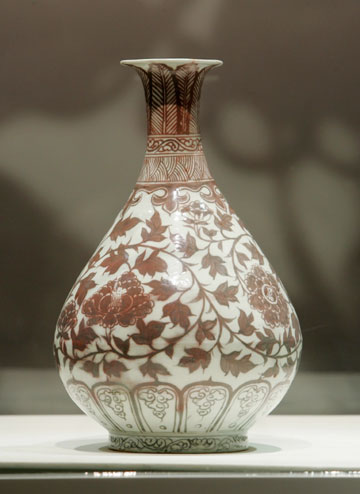
Steve Wynn just paid over $10 million for this Ming vase. It is a lovely object - deserving of much affection, and I hope this is prominently on display in Vegas - but I guess I don't love it "$10 million dollars" much. Still, I'd be glad to ogle it like this fellow. You can tell, he likes his pottery.

Meanwhile, in a museum far far away, this hapless buckeroo helped increase the value of other vases:
"I snagged my shoelace, missed the step and 'crash bang wallop,' there was a million pieces of high-quality Qing ceramics lying around beneath me," Nick Flynn told BBC radio.

"There is no way my pocket will stretch to reimburse them for the damage that I have done".

The museum staff (The Fitzwilliam) vowed to glue the pieces together, and asked the patron to never come back, please.

Wednesday, May 17, 2006

Happy Birthday Cultural Revolution!

Just 40 years ago Mao's pet project made its painful destructive mark on one of the most impressive and awesome cultures ever. Good going Mao! That same People's Party seems intent to go through this milestone in silence with its hand over its face. A worthy gesture for this occasion? Take his portrait off the Forbidden City and hit it, Iraqi style, with a shoe.

Wednesday, April 19, 2006

The Peoples' organs

Gateway has a disturbing post on China harvesting organs from prisoners. A concentration camp in China is like a fish farm here. At this rate, China is a shoe in for the UN Human Rights Council.

Tuesday, April 18, 2006

Who’s meeting Hu?

I’d like to see the complete guest list for Gate’s Hu dinner. Not to use it against those people or their companies, but for curiosity’s sake. Microsoft, Boeing, Starbucks – fine. Who else? The more business hands Hu shakes, the better.

Thursday, March 23, 2006

China wants to develop an animation industry

Angry Chinese Blogger has the scoop. I'd be curious to get 8th Man's take, as he has personal experience with animation and China.

Friday, March 17, 2006

Two Chinese snowscapes...

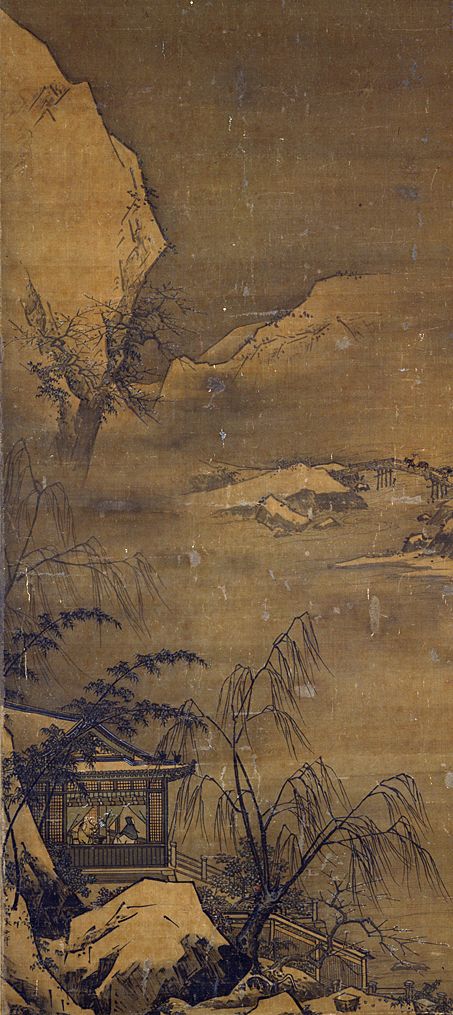
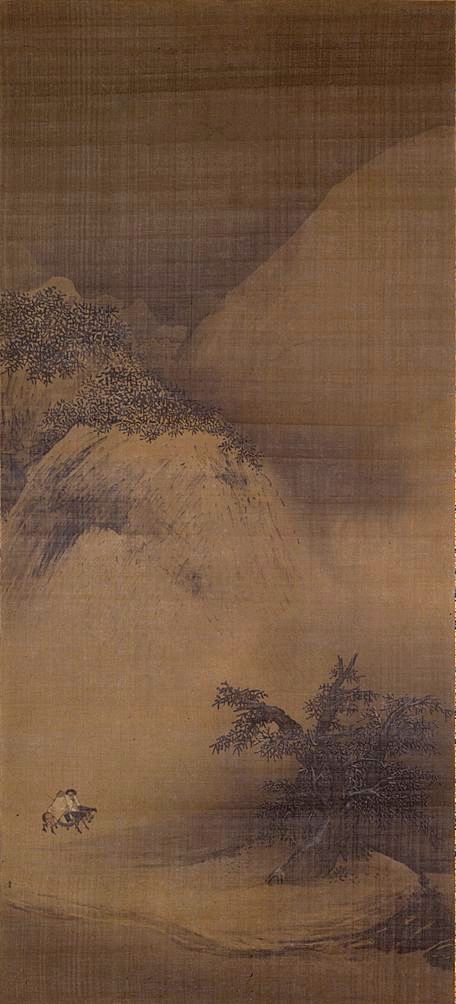
With the passing of winter, I figured I'd pay a little belated tribute to snow:

The first one is from Sun Jun-ze during the Yuan Dynasty (1280-1370). You'd think that Mongol hordes could ruin a culture, but they didn't, at least not judging by this kickingly serene pavilion. Chinese art has a way of layering backgrounds in such a manner as to create the absence of depth. It's not flat, but airy and flat. Very exotic...


The second snowscape is from the previous Song Dynasty (10th-13th century) by Liang Kai (1279). The Song dynasty was a docile empire that eagerly shed any interest in maintaining a strong military, making it vulnerable to Mongol aggression down the road. That it lasted so long is a testament to the strength of Chinese culture and institutions. It's one of my favorite dynasties (which explains why I'm blogging on a Friday night), but I digress. Here we have two riders swallowed up in an immense but non-threatening nature.

Thursday, March 02, 2006

A couple comments about the new DVD release of Raise the Red Lantern

This is perhaps the best movie in the Gong Li or Zhang Yimou cannons – and that is saying quite a bit. Its release on DVD has been long overdue. Unfortunately, the new release was from a scratchy old print and the subtitles read like awkward instructions on a Chinese food product (i.e. “cook until goodly warm”). I don’t remember these same issues on the old VHS release (though that VHS version was not letterboxed). I bring this up because I’d recommended the film in a previous post about Memoirs of a Geisha. The recommendation still stands – the film’s greatness is still apparent – but there has not been a release of this film on video or DVD that has done it justice.

Thursday, February 16, 2006

Meet Cowpea red

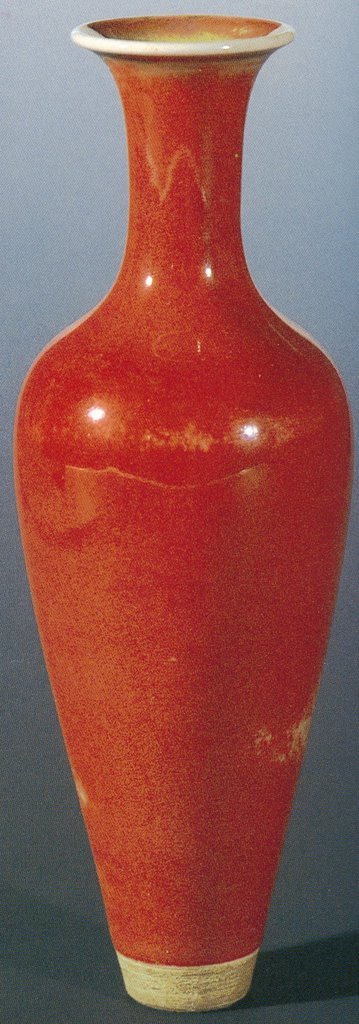
She enjoys soft music and intimate candle-lit dinners. She likes it when her partner says silly things like "Gee, I'd like to drink soup out of you," though she'll admit that to do so might be a bit awkward. She doesn't mind ticklish facial hair but prefers clean shaven men - and occasionally a grease mustache (in case Wagstaff is interested). She considers herself Jingdezhen Ware. Although she is from the Kangxi Reign, she admits to lying about her age and saying she's from the Xianfeng Reign. She recently divorced a gourd-shaped vase and is very very available.

Chinese pottery speaks for itself

There's a reason we call nice dinnerware 'China': Chinese pottery is the best.

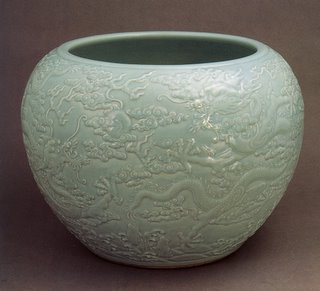
Qing pottery dazzles with vibrant colors. But strip that away, and what do you have? Well, you still have impressive detail as this celadon piece dating from the 18th century shows:


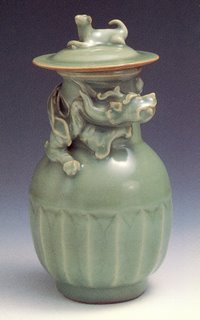
However, I prefer the more elegant Song style of pottery shown in this celadon jar dating from around 1127 to 1279:

The green is so deep in the smoothness of the Song piece that you think you could just walk right into it, whereas the detail in the Qing piece keeps your eye at the surface.

Tuesday, February 14, 2006

Beautiful Chinese ceramics...

This vase is from the Qing dynasty (ca 1736-1795). On display at The Shanghai Museum. Lots of good stuff there.

Tuesday, January 10, 2006

The People’s government simply cannot understand freedom

A meeting between Chinese and Japanese diplomats in Beijing on Monday made
little headway in resolving bilateral issues….

Hmm, I wonder what’s getting in the way this time: Koizumi at Yasukuni again? Did a Chinese actress portray another Japanese lady in a glossy American movie? Perhaps some salaryman was overheard disparaging the character of a Chinese person?

"….with discussion instead focusing on whether Japan should put a muzzle on the
nation's news media.”

And then the Chinese foreign minister, presumably with a straight face, asks:

"Why does the Japanese media only focus on the negative aspects of China?" asked
Cui Tiankai, director-general of Asian affairs at the Chinese foreign ministry,
according to Japanese officials present at the meeting.

The obvious Chinese solution:

"In order to produce good coverage, the government in China provides guidance to
the media. The Japanese government should provide similar guidance," Cui said.

And with help from Microsoft and Google, such "guidance" has never been easier!

Incidentally, you’d be hard pressed to find much in the way of positive news about Japan in the Chinese papers. But that's different, since Japan is evil, right?

The laughs don’t stop there. The story ends with one Chinese official lamenting:

"While we have built up a mature relationship with the United States, it is
regrettable that we cannot do the same with our neighbor, Japan."

That is a pity, but one that's easily remedied. Simply act like an adult. Problem solved.

Thursday, January 05, 2006

No kidding

Prime Minister Junichiro Koizumi criticized China and South Korea during his New
Year's news conference Wednesday, claiming it is Beijing and Seoul, not Tokyo,
that should work to resolve their long-standing gripes over his repeated visits
to Yasukuni Shrine.

Read down the story a bit, and you get to the source of the problem:

Koizumi described his decision to continue his shrine visits as "a matter of the
heart" that should not be interfered with by anyone who respects
freedom of thought
.

Well, that leaves out the People's Party.

Tuesday, December 27, 2005

China prefers no reform at the UN

Vice-Foreign Minister Qiao Zonghuai Monday reiterated China's position in the
reform of the United Nations (UN), saying "priority (of the reform) should be
given to increasing the representation of developing countries especially
African countries."

Translation: the 2nd largest economy in the world should not be on the security council.